
My first home workout lasted nine minutes. Then I sat on the floor and questioned every decision I had ever made.
Nobody ever gave me proper fitness tips for beginners at home. I just kind of figured I would push the table aside, do some squats, and things would sort themselves out.
They did not. I got sore in places I forgot I had. I skipped sessions. I started over four times in two months. And somewhere in that mess, I actually figured out what works.
This is not a professional guide. I am not a trainer. I am just someone who spent a year working out in a small bedroom, made a lot of stupid mistakes, and eventually stopped making them.
If you are starting from zero, this is probably more useful than anything written by someone who has been fit their whole life.
Week One Was Genuinely Awful
I want to be upfront about this because nobody else is.
The first week hurts. Not a little sore hurt. I mean I cannot sit down without grabbing the wall hurt. My legs were done after ten squats.
My arms gave out during push-ups. I held a plank for eight seconds before collapsing.
And I kept thinking is this normal? Am I just too unfit for this? Should I have started slower?
Yes. I should have started slower. That is the thing. I went in trying to do a full 30-minute session because that is what the internet told me to do. My body was not ready for that. Nobody’s is on day one.
What actually helped: I cut everything down to 15 minutes. Three sessions that first week. Just 15 minutes each. And I finished every single one. That felt better than any ambitious plan I had given up on before.
I Skipped Warm-Ups and Paid for It
Two weeks in, I pulled something in my lower back doing a lunge. Not a pop, not a snap just this dull tug that made me stop and stand very still for a few seconds.
Five days off. Which, when you are trying to build a new habit, is basically starting over.
The reason? I had been jumping straight into lunges and squats with cold muscles. No warm-up. Every single session. Because it “wasted time.”
After I recovered, I started doing five minutes of this before every session. No exceptions:
- March in place for 30 seconds
- Arm circles – 10 forward, 10 backward
- Leg swings, 10 per leg, holding the wall
- Hip circles, slow, 10 each side
- Light jumping jacks, 30 seconds
Five minutes. That is all. Since I started doing this, I have not had a single injury. I also do 3–4 minutes of stretching after — hamstrings, back, shoulders. The next-day soreness dropped a lot once I added that.
Nobody Told Me I Was Breathing Wrong
Around week three I started getting dizzy mid-workout. Not every session just sometimes. I blamed it on eating too early, or the room being hot, or just being unfit.
Turns out I was holding my breath during the hard parts of every rep. Squatting down holding. Pushing up holding. Just tensing up and forgetting to breathe entirely.
The fix is simple. Breathe out on the hard part. Breathe in on the easy part.
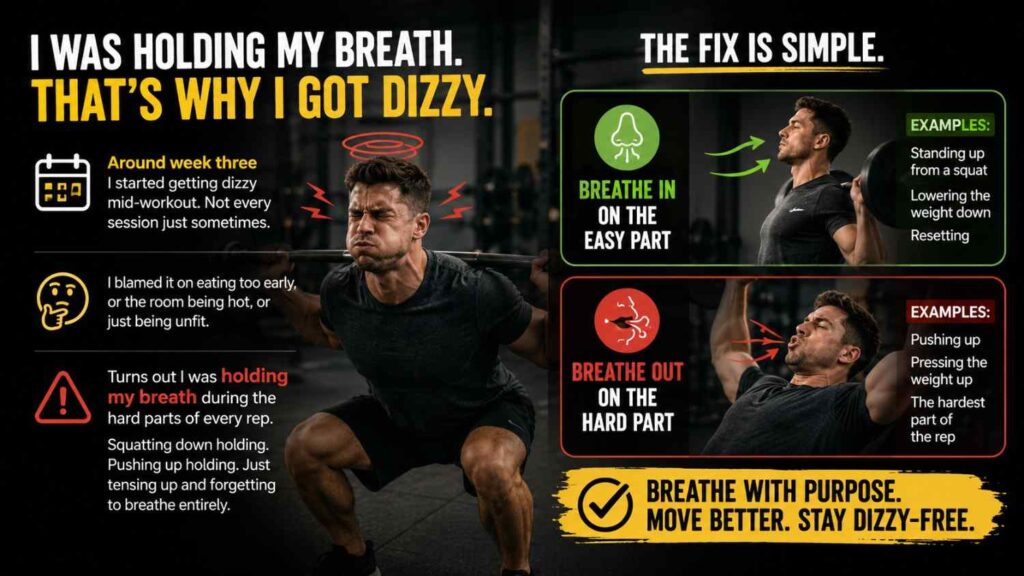
Push-up going down breathe in. Pushing back up breathe out. Squat going down breathe in. Standing back up breathe out.
I know that sounds obvious. It was not obvious to me. And once I actually did it, my stamina in a session jumped almost immediately. I was not tired I was just not breathing.
How I Actually Made It Stick
I had tried to get fit before. Three or four times over the years. Always the same story strong start, two weeks of skipping, complete stop.
What was different this time was one small decision. I stopped trying to feel motivated and just attached the workout to something I was already doing.
My coffee takes about four minutes to brew. So I started doing my warm-up while it brewed. Every morning. No decision needed. Coffee goes on, warm-up starts. By the time I poured my cup, I was already moving.
I also kept a tiny notebook. Not an app a physical notebook. Date, what I did, a note on how I felt. Nothing fancy.
But flipping back through it after six weeks and seeing 14 entries that did something to my head in a good way.
I stopped using the scale too. The scale was messing with my head. Instead I tracked things like: can I do more push-ups than last Monday?
Is my plank time going up? Do my legs feel stronger on stairs? Those things moved. And they moved in a way the scale did not show.
Making Workouts Harder Without Buying Anything
Month two. The basic stuff started feeling easy. Ten squats, done. Five push-ups, easy. I wanted to go harder but I did not want to spend money on weights.
Someone told me to try slowing down. Not doing more reps just doing the same reps, slower.
I tried it. A squat where you take three seconds to lower down is a completely different exercise from a fast squat. My legs were burning after eight of them. Same exercise. Same no equipment. Just slower.
That is the idea behind progressive overload. You keep asking your muscles to do a little more each week.
It does not have to mean heavier. It can mean slower, or longer holds, or one-leg versions of things. Here is roughly what my eight weeks looked like:
- Weeks 1–2: Short sessions, basic moves, just getting the habit in
- Weeks 3–4: Same exercises, slowed way down
- Weeks 5–6: Added a fourth workout day, started walking on rest days
- Weeks 7–8: Single-leg squats, longer planks, deeper lunges
Zero equipment. Zero cost. Just the same living room.
Mistakes I Made So You Do Not Have To
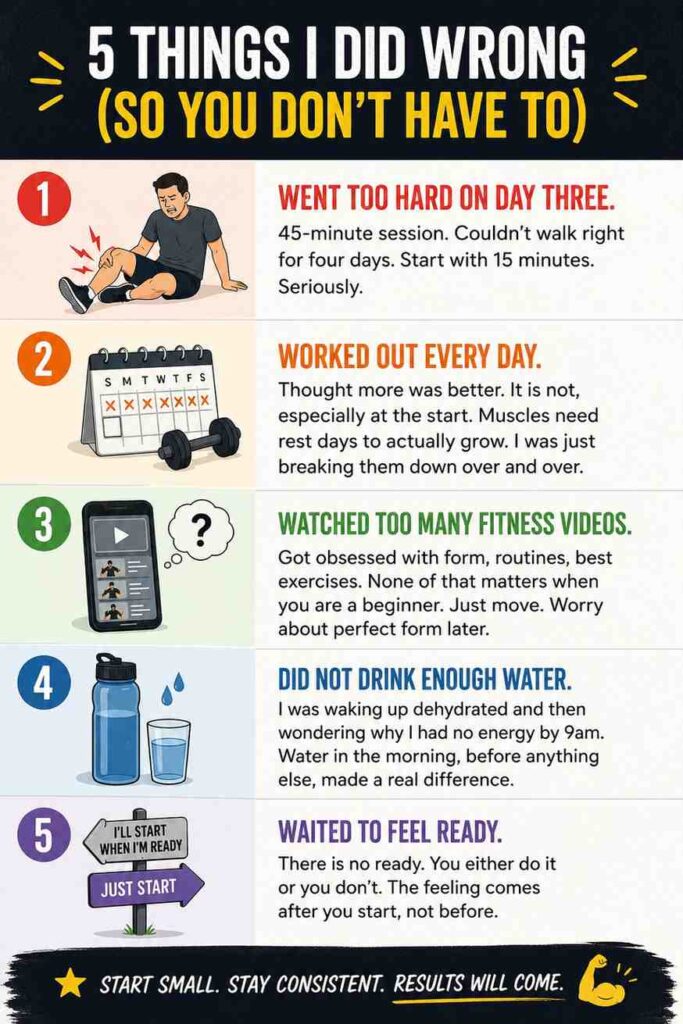
Looking back, I wasted probably a month of progress by repeating the same errors. Here they are, plainly:
- Went too hard on day three. 45-minute session. Couldn’t walk right for four days. Start with 15 minutes. Seriously.
- Worked out every day. Thought more was better. It is not, especially at the start. Muscles need rest days to actually grow. I was just breaking them down over and over.
- Watched too many fitness videos. Got obsessed with form, routines, best exercises. None of that matters when you are a beginner. Just move. Worry about perfect form later.
- Did not drink enough water. I was waking up dehydrated and then wondering why I had no energy by 9am. Water in the morning, before anything else, made a real difference.
- Waited to feel ready. There is no ready. You either do it or you don’t. The feeling comes after you start, not before.
Just Start. Even If It Goes Badly.
My first session was nine minutes long. I wanted it to be thirty. Nine is what happened.
And that nine-minute session is the reason I kept going. Because I finished it. It was small and a bit embarrassing and I was out of breath, but I did it. The next one was eleven minutes. Then fourteen.
A year later I work out four days a week, in the same small bedroom, with no equipment, and I feel better than I have in a long time.
You do not need to be ready. You do not need a plan. Push the table aside and do ten squats. That is enough for today.
If you read other blog about Summer Weight Gain Diet Plan
If you read other blog about hydration summer health tips
How long until I see actual results?
Energy and mood honestly, about two weeks. My afternoon slump got shorter. I slept heavier. The physical stuff you can see in a mirror took closer to ten weeks. Most people stop around week five, which is right before things start showing. That is the brutal part.
Can I build muscle without weights at home?
Yes. Your muscles do not care what is loading them. Gravity is enough, especially when you are starting out. Push-ups, squats, glute bridges, planks — done slowly and consistently, they build real muscle. I have seen the difference in my own arms and legs. It works.
Is it fine to work out every day?
For a beginner, no. Three days a week is plenty. The other days, go for a walk if you want to move. Your muscles need time to repair. I ignored this and it slowed me down. Rest is part of the plan, not a break from it.
Morning or evening — which is better?
Whichever one you will actually do. That is genuinely the answer. Morning worked for me because evenings were unpredictable. But I know people who work out at 9pm and are totally consistent. The time does not matter. Showing up does.
Why am I more sore on day two than day one?
It is called DOMS (delayed onset muscle soreness). It peaks around 24 to 48 hours after the workout, not right after. It happens because the muscle fibres are repairing themselves from the stress you put on them. Light movement, lots of water, and a warm shower help. It does fade as your body adjusts.
1 thought on “Fitness Tips for Beginners at Home: What Actually Worked for Me”