
Honestly, I was that person who thought getting healthy meant a gym membership and a six-day workout plan.
I am joining a gym twice a day. Went for maybe two, three weeks maximum, then stopped completely.
The second time, I didn’t even feel guilty. I just knew it wasn’t for me.
But here’s the thing. I still wanted to feel better. Less tired, less heavy, less like I was running on fumes by 3 PM.
I just didn’t want the gym to be part of that answer.
So I started experimenting nothing crazy, nothing from a fitness influencer’s page. Just small, doable things that actually fit into my real day. And slowly, they worked.
If you read other blog about How to Reduce Belly Fat at Home Naturally
If you’re looking for healthy lifestyle tips without gym memberships or complicated routines, this is the honest version of what helped me. No fluff, no transformation stories. Just what I actually did.
Why You Don’t Need a Gym to Live a Healthy Lifestyle
Let me say something that nobody in the fitness world really wants to admit one gym session a week does almost nothing if you’re sitting still the other six days.
I’ve seen people with gym memberships who are exhausted all the time. And I’ve seen people who never step foot in a gym who look and feel great.
The difference isn’t the gym. It’s what they do with the rest of their day.
Daily movement even gentle, boring, unglamorous movement, matters way more than one big workout Walking, Stretching.
Taking the stairs. Standing up every hour. These things add up in a way that feels invisible until suddenly, a few weeks later, you notice you’re not tired by noon anymore.
I started with 15-minute walks after dinner. That was it. No plan, no tracker, no goals. Just a walk around the block after eating.
Within three or four weeks, my sleep improved. My mood was noticeably better. I wasn’t dragging myself out of bed every morning.
That one tiny habit showed me what consistency actually feels like — and it had nothing to do with a gym.
Start Your Morning With Simple Healthy Habits
My mornings used to go like this: alarm, phone, scroll, panic about time, rush out the door, skip breakfast. Every single day.
Changing that routine — even partially — made a bigger difference than I expected.
Drink Water After Waking Up
This sounds too simple to matter. It isn’t. After 7-8 hours of sleep your body is genuinely dehydrated.
Drinking a glass of water before anything else — before chai, before checking messages — helps your digestion wake up and clears some of that early morning brain fog.
I started keeping a bottle next to my bed so I didn’t have to think about it.
Stretch for 5–10 Minutes
Not yoga. Not a full routine. Just whatever feels stiff — roll your neck, stretch your arms up, loosen your lower back.
Five minutes. That’s all It tells your body that the day has started and you’re going to move around in it.
Avoid Checking Your Phone Immediately
This one’s hard. I still mess it up sometimes. But even giving yourself 20 minutes in the morning without a screen lowers your stress before the day even really begins. You’re not reacting to things before you’ve had a chance to wake up properly.
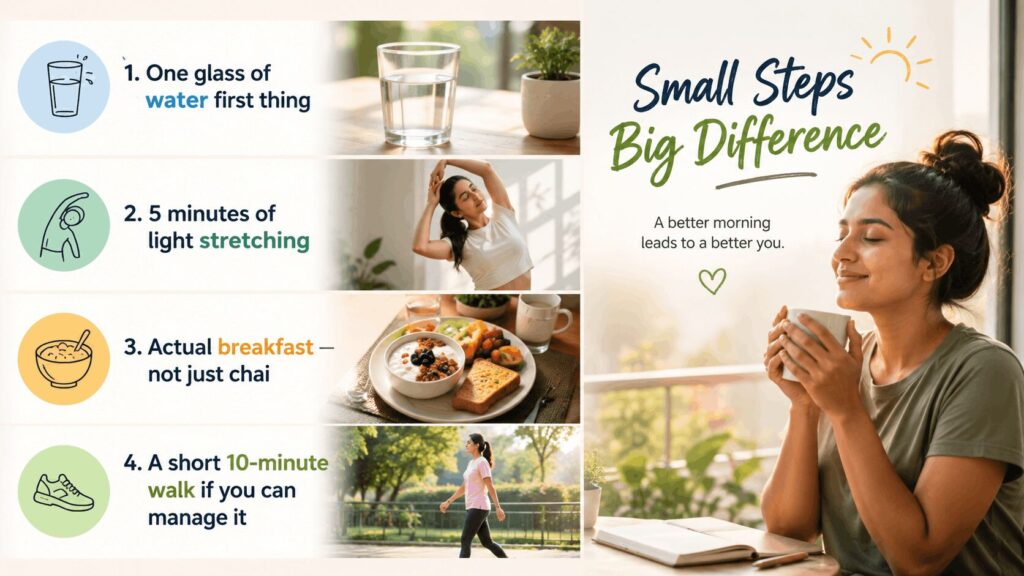
A simple morning routine that works:
- One glass of water first thing
- 5 minutes of light stretching
- Actual breakfast — not just chai
- A short 10-minute walk if you can manage it
Walk More During the Day
Walking doesn’t feel like exercise. That’s exactly why it works for people who hate exercising.
When I started using stairs instead of the elevator at work, I didn’t think of it as a fitness decision. It was just slightly less lazy.
Then I started pacing during phone calls instead of sitting. Then a short walk after lunch. Then the evening walk I already mentioned.
None of it felt like effort. It just became the way I moved through my day.
Can walking replace gym workouts? For most regular people not athletes, just people wanting to feel better and manage their weight
yes. A 30-minute brisk walk most days does more for your overall health than occasional intense gym sessions that you struggle to maintain.
It’s not identical to strength training, but for energy, heart health, and mood, walking is genuinely hard to beat.
Healthy Eating Habits Without Following a Strict Diet
I’m not going to tell you to count macros or cut out carbs. I tried that. It lasted nine days and made me miserable.
What actually worked was making small swaps over time — not all at once, not perfectly, just slowly shifting what was normal for me.
Eat More Home-Cooked Meals
When you make food at home, you automatically use less oil and salt than any restaurant or packaged option. I’m not a good cook. My meals are simple — dal, sabzi, eggs, roti. But even basic home food is almost always better than ordering in every day.
Reduce Sugary Drinks
Swapping soda and packaged juices for nimbu paani, plain water, or chaas was probably the single change that made the fastest visible difference. Those afternoon energy crashes I used to get? Mostly gone within two weeks.
Add Protein and Fiber to Meals
Not complicated. Just make sure your plate has some protein — dal, eggs, paneer, curd — and some vegetables. That combination keeps you full longer and reduces the urge to snack on junk an hour later.
Keep Healthy Snacks Nearby
My simplest trick: I stopped buying chips and biscuits in bulk. When I’m hungry and there’s fruit or makhana on the counter, I eat that.
When there’s a packet of namkeen, I eat that. Your environment makes the decision before your willpower gets a chance.
| Unhealthy Habit | Better Swap |
|---|---|
| Cold drinks / soda | Nimbu paani or coconut water |
| Chips or namkeen | Roasted makhana or mixed nuts |
| Ordering food daily | Simple home-cooked meals |
| Packaged juice | Whole fruit or homemade smoothie |
Create an Easy Home Activity Routine
There’s no rule that says movement has to look like exercise. Some of the things that kept me active most consistently:
- Dancing — I’m a bad dancer. Doesn’t matter. Ten minutes of moving to music you actually like burns more than you’d think and genuinely lifts your mood.
- Yoga — Even the most beginner-level yoga does something. Flexibility improves. Stress goes down. Start with 15 minutes and free YouTube videos.
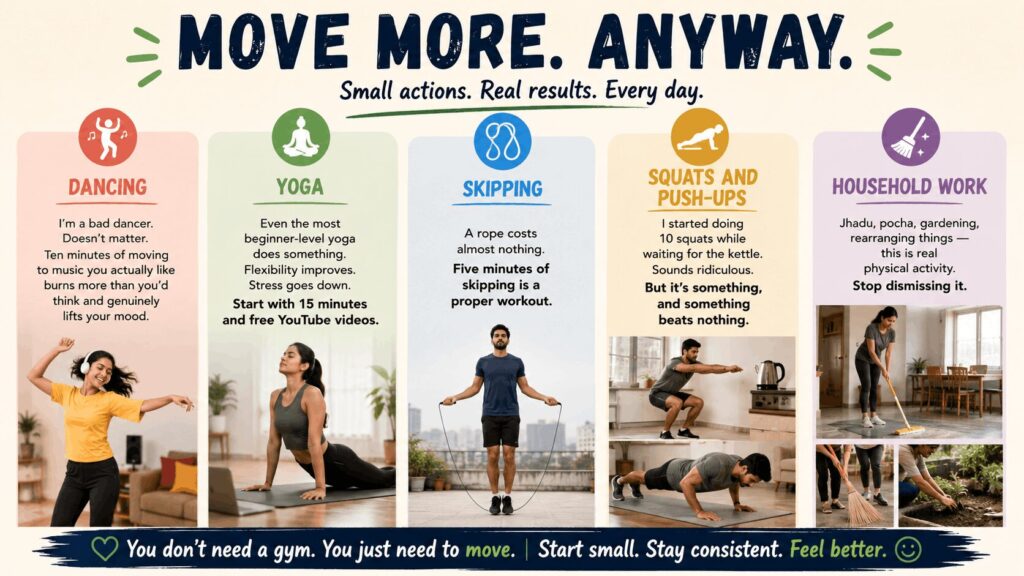
- Skipping — A rope costs almost nothing. Five minutes of skipping is a proper workout.
- Squats and push-ups — I started doing 10 squats while waiting for the kettle. Sounds ridiculous. But it’s something, and something beats nothing.
- Household work — Jhadu, pocha, gardening, rearranging things — this is real physical activity. Stop dismissing it.
A home fitness routine doesn’t need to be a routine in the strict sense. It just needs to happen — in whatever broken, inconsistent, imperfect way that works for your actual life.
Improve Sleep and Reduce Stress Naturally
Here’s what I didn’t understand for a long time: you can walk every day and eat okay and still feel terrible if your sleep is bad and your stress is high. Sleep and stress management aren’t bonus habits — they’re the foundation.
Sleep Earlier
I was a 1 AM person. Not by choice, just by habit. Gradually shifting to sleeping before 11 changed how I felt in the mornings more than almost anything else. Your body does actual repair work while you sleep. It’s not lazy — it’s necessary.
Reduce Screen Time at Night
The light from your phone keeps your brain thinking it’s daytime. Putting it away 30-40 minutes before sleeping — even if you just read or sit quietly — noticeably improves sleep quality within a few days.
Spend Time Outdoors
Even 15 minutes of sunlight during the day helps your mood and regulates your sleep cycle. A walk to the corner shop counts. Sitting on a balcony counts. Being outside counts.
Practice Deep Breathing
When things feel overwhelming — 4 counts in, hold for 4, out for 4. Repeat it a few times. It’s not magic but it genuinely slows your nervous system down when you’re spinning out.
How does sleep affect a healthy lifestyle? Quite directly. Bad sleep raises hunger hormones, drops your energy, affects your mood, and makes it harder to make good decisions about food and activity. If you fix one thing, fix sleep.
Small Daily Habits That Made the Biggest Difference for Me
None of what I changed was impressive on paper. If I told someone “I started drinking more water and going to bed earlier,” they’d think I was joking about a health transformation.
But this is genuinely what shifted things:
- Drinking water through the day, not just when I was thirsty
- Walking after at least one meal daily
- Eating slower — actually chewing food instead of inhaling it
- Stopping late-night eating (this one took a while)
- Getting to bed before midnight most nights
- Finding small ways to move instead of defaulting to sitting
The mindset change mattered as much as the habits. I stopped trying to see fast results and started just trying to feel okay today. That made everything easier to keep doing.
Beginner-Friendly Healthy Lifestyle Routine Without Gym
If you want a simple daily structure to start with, here’s one that doesn’t require any special equipment or a big time commitment:
Morning
- Water before anything else
- 5-10 minutes of stretching
- Breakfast with some protein in it
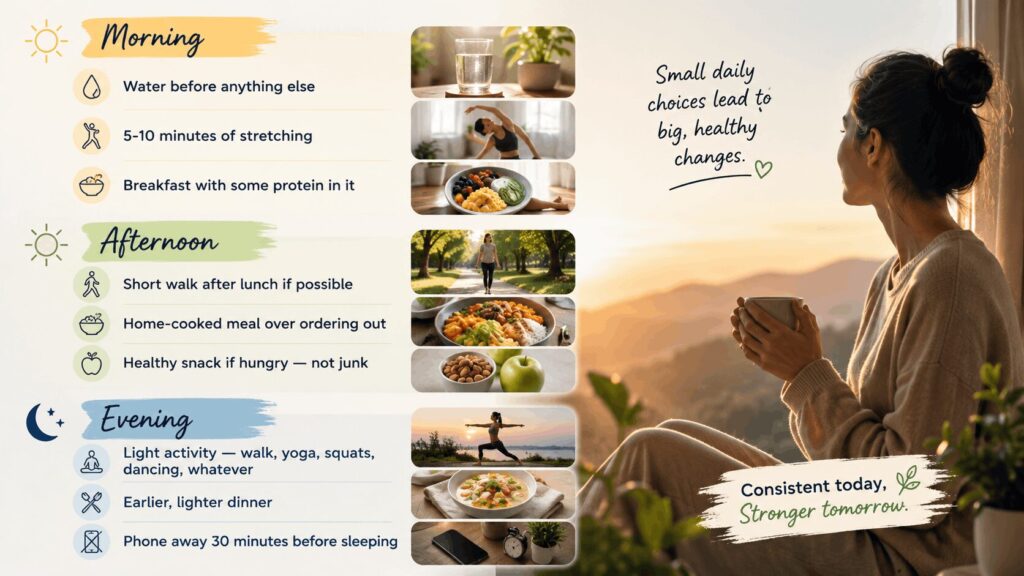
Afternoon
- Short walk after lunch if possible
- Home-cooked meal over ordering out
- Healthy snack if hungry — not junk
Evening
- Light activity — walk, yoga, squats, dancing, whatever
- Earlier, lighter dinner
- Phone away 30 minutes before sleeping
That’s it. Adjust it to what works for you. The point is to have something to return to on the days when everything falls apart — because those days will happen.
Conclusion
I’m not fitter than I was at 22. I’m not running half-marathons. But I feel genuinely better than I did two years ago — more energy, better sleep, less of that constant low-grade exhaustion that I used to think was just normal adult life.
None of it required a gym. It required being a bit more honest about what I could actually maintain.
Start with one thing. Seriously, just one. Walk a bit more, or drink more water, or sleep 30 minutes earlier. See how that feels for two weeks before adding anything else.
Following these healthy lifestyle tips without gym can help you feel more active, energetic, and balanced without expensive memberships, complicated plans, or the pressure to be perfect. Your health doesn’t need a perfect start. It just needs a start.