
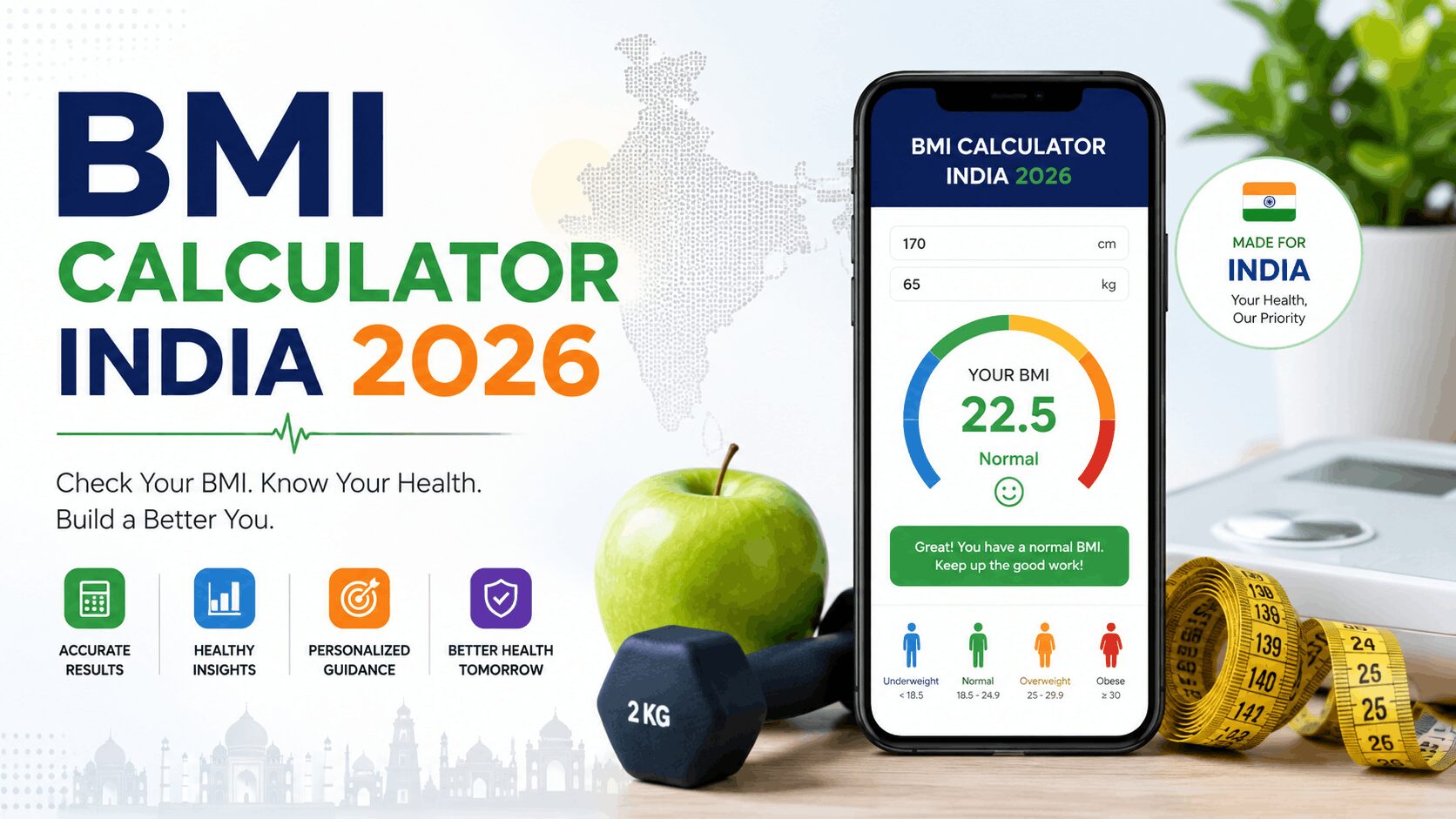
What Is BMI and Why Should You Care?
BMI — Body Mass Index — is a number that tells you whether your weight makes sense for your height. It doesn’t measure fat directly, but it gives doctors and health professionals a fast, low-cost way to flag potential weight-related risks.
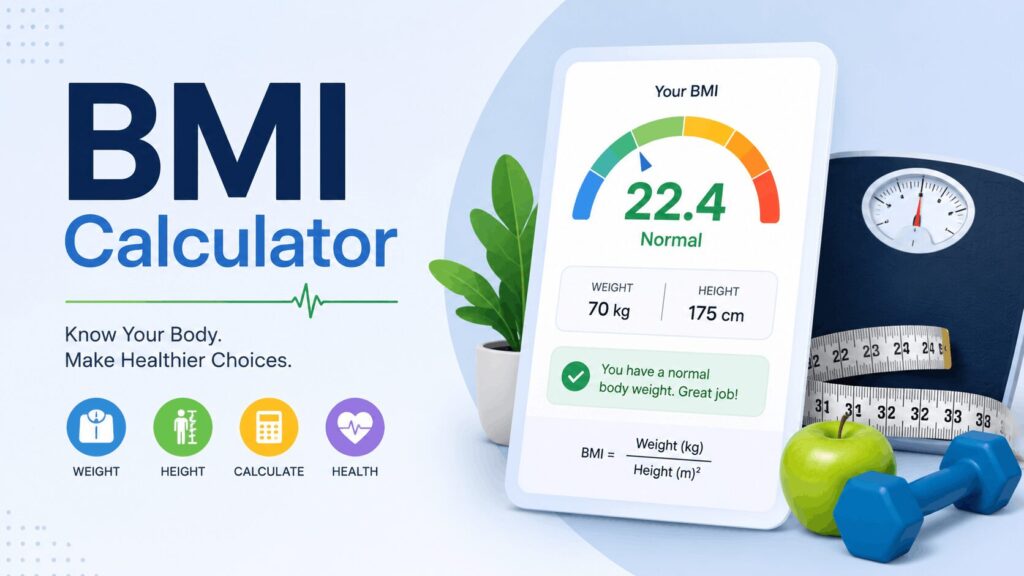
The formula is simple:
BMI = Weight (kg) ÷ Height² (m²)
If you weigh 70 kg and stand 1.70 m tall, your BMI is 70 ÷ (1.70 × 1.70) = 24.2 — squarely in the healthy range.
This number has been used in clinical practice for decades. But in 2025 and 2026, new ICMR guidelines for Indians have pushed the conversation further — because the old WHO cutoffs weren’t built with the Indian body type in mind.
BMI Categories: What the Numbers Actually Mean
Here are the standard WHO BMI ranges that most online BMI calculators use:
| BMI Range | Category |
|---|---|
| Below 18.5 | Underweight |
| 18.5 – 24.9 | Healthy Weight |
| 25.0 – 29.9 | Overweight |
| 30.0 – 34.9 | Obese (Class I) |
| 35.0 – 39.9 | Obese (Class II) |
| 40 and above | Severely Obese (Class III) |
These numbers work fine for a broad population. But they miss something critical — and that’s especially true for people in India.
BMI Calculator for India: Why Indians Need Different Cut offs
Here’s what most online BMI tools won’t tell you: Indians are at higher health risk at a lower BMI than Caucasian populations.
Research and ICMR guidelines recognize this. For South Asians, including Indians:
- Overweight begins at BMI ≥ 23 (not 25 as in the WHO standard)
- Obesity begins at BMI ≥ 25 (not 30)
This isn’t a minor tweak. It means a 5’6″ Indian man weighing 80 kg might get a normal result on a generic BMI calculator — but an India-specific tool would correctly flag him as overweight.
Why the difference? Indians tend to carry more visceral fat (fat stored around internal organs) even at lower body weights.
This thin-fat phenotype is a documented phenomenon — someone can look lean but still have dangerous fat deposits around the liver and heart.
Over 13.5 crore Indians are estimated to live with obesity. That number keeps growing, partly because standard BMI tools give people false reassurance.
Practical tip: If you’re using a BMI calculator in India, look for one that uses Asian-Indian cutoffs (Overweight ≥23, Obese ≥25). The difference could change how urgently you act.
BMI Calculator for Males: What Men Need to Know
Men and women have fundamentally different body compositions, and this affects how BMI results should be read.
For men, healthy BMI falls between 18.5 and 24.9 (or below 23 for Indian men, per ICMR recommendations).
Why BMI Can Be Misleading for Men
A bodybuilder with 90 kg of lean muscle and 5% body fat can easily hit a BMI of 28 — technically overweight. That number is meaningless in their context.
BMI cannot tell the difference between fat and muscle. So for men who strength train or play sports, always pair BMI with waist circumference measurement.
A waist above 90 cm in Indian men signals abdominal obesity regardless of BMI.
Health Risks Linked to High BMI in Men
- Type 2 diabetes
- Cardiovascular disease and hypertension
- Fatty liver disease
- Reduced testosterone levels
- Sleep apnea
Men with a BMI below 18.5 face their own risks — reduced muscle mass, lower immunity, and nutritional deficiencies that often go unaddressed because the focus is always on overweight.
BMI Calculator for Females: Key Differences That Matter
Women naturally carry more body fat than men — and that’s biologically normal. Even at the same BMI, women will typically have 8–10% more body fat than men. Standard BMI charts don’t reflect this difference in their cutoffs, which is a known limitation.
Special Situations Where BMI Doesn’t Apply for Women
During pregnancy: BMI is not a reliable tool once pregnancy begins. Weight gain in pregnancy is expected and healthy. Healthcare providers track gestational weight gain using separate guidelines, not BMI.
After menopause: Hormonal shifts lead to fat redistribution — more fat around the abdomen and less around the hips.
A woman’s BMI may stay the same, but her health risk profile changes significantly. Waist circumference (above 80 cm is high risk for Indian women) becomes a more useful metric.
With PCOS: Women with polycystic ovarian syndrome often present with insulin resistance and weight gain. BMI may underestimate the risk here. Always combine it with a blood glucose test and PCOS diet plan to control.
BMI Calculator by Age: How Age Changes the Picture
Age reshapes body composition in ways that BMI calculations don’t always catch.
Adults (20–39 years)
Standard BMI ranges apply. For Indians, use the modified cutoffs (overweight ≥23). This is the window where habits form. A BMI trending toward 22–23 with active lifestyle choices lowers lifetime disease risk significantly.
Middle Age (40–59 years)
Muscle mass naturally declines from around age 30 — roughly 3–8% per decade. As muscle drops, fat increases. A person’s BMI might stay steady while their body fat percentage rises. This is called sarcopenic obesity — dangerous precisely because it hides behind normal numbers.
Seniors (60+ years)
For older adults, a slightly higher BMI (23–27) may actually be protective against frailty and bone loss. The evidence here is nuanced — underweight elderly individuals face higher risks of falls, fractures, and mortality than those who are slightly overweight.
Children and Teenagers (2–19 years)
BMI works differently for kids. The same number means different things at different ages and genders. Paediatricians use BMI-for-age percentile charts — developed by the CDC and adapted for Indian populations by the Indian Academy of Pediatrics (IAP):
- Below 5th percentile → Underweight
- 5th to 85th percentile → Healthy weight
- 85th to 95th percentile → Overweight
- Above 95th percentile → Obese
A 10-year-old and a 16-year-old with identical BMI values are in very different health situations. Never use adult BMI tables for children.
How to Use a BMI Calculator Correctly (Step-by-Step)
- Measure your height accurately — stand straight against a wall, no shoes
- Weigh yourself in the morning — after using the toilet, before eating
- Enter weight in kg and height in cm into the calculator
- Note your BMI value and check against India-specific cutoffs if you’re South Asian
- Add your waist measurement for a more complete picture
That’s it. Three inputs, five steps, one useful starting number.
What BMI Doesn’t Tell You (And What to Do About It)
BMI is a screening tool, not a diagnosis. Here’s what it misses:
- Fat distribution — belly fat is riskier than fat on hips and thighs
- Muscle mass — athletes will often read as overweight
- Bone density — heavier bones raise BMI without adding fat
- Metabolic health — someone can have a healthy BMI but high blood sugar and cholesterol
For a more complete health picture, pair your BMI with:
- Waist-to-height ratio (ideal: below 0.5)
- Fasting blood glucose and HbA1c
- Lipid profile (cholesterol, triglycerides)
- Blood pressure
Quick Reference: Healthy BMI Ranges for India
| Group | WHO Standard | India-Specific (ICMR) |
|---|---|---|
| Adult Men & Women | 18.5 – 24.9 | 18.5 – 22.9 |
| Overweight | 25 – 29.9 | 23 – 24.9 |
| Obese | ≥ 30 | ≥ 25 |
| Senior Adults | 18.5 – 24.9 | 23 – 27 (may be protective) |
| Children | Percentile-based | IAP percentile charts |
Final Word: Use BMI as a Starting Point, Not an Endpoint
A BMI calculator gives you one data point. It’s free, fast, and accessible — and that matters, especially in a country where millions don’t have easy access to advanced diagnostics.
But treat it for what it is: a first flag, not a final answer.
If your BMI is above 23 (using Indian cutoffs) or below 18.5, that’s worth discussing with a doctor — particularly if you’re also seeing numbers climb on your blood pressure, blood sugar, or cholesterol.
The best version of this tool is the one that makes you ask the right questions, not the one that just hands you a number and sends you away.