
Introduction
Last year, my cousin came to me complaining about two things — constant tiredness and skin that kept breaking out. She had tried every face wash in the market. Nothing worked. I asked her one simple question: How is your digestion? She looked confused.
That’s the problem. Most of us never connect our gut health to our skin, our mood, or our energy. We just live with small problems. Bloating after lunch. A heavy stomach at night. Irregular digestion. We call it stress and move on.
But the gut is not just about digestion. It controls a lot more than we think. A healthy gut means better energy, clearer skin, deeper sleep, and a stable mood. A troubled gut can silently disturb all of these.
In this article, I will walk you through 10 warning signs that your gut may be struggling. I will also share what causes it and simple ways to fix it no crash diets, no expensive products.
If you read other blog about Symptoms of Flu in 2026
What Is an Unhealthy Gut?
Your gut is home to trillions of bacteria. Some are good. Some are bad. When they stay in balance, your body works well. You digest food properly. You absorb nutrients. Your immune system stays strong.
An unhealthy gut happens when the balance of bacteria in the digestive system is disturbed. Doctors call this condition “gut dysbiosis.” It sounds complicated, but the idea is simple — the bad bacteria start to outnumber the good ones.
This happens for many reasons. Eating too much junk food. Not sleeping enough. Living under constant stress. Taking antibiotics too often. All of these can slowly upset the gut’s natural balance.
The tricky part? Your gut problems don’t always stay in the stomach. Research published in the journal Microorganisms (2024) by scientists at Stanford and the University of Copenhagen found that gut imbalance can affect skin, energy, immunity, and even brain function. Your gut trouble can show up on your face or in your mood without you ever linking the two.
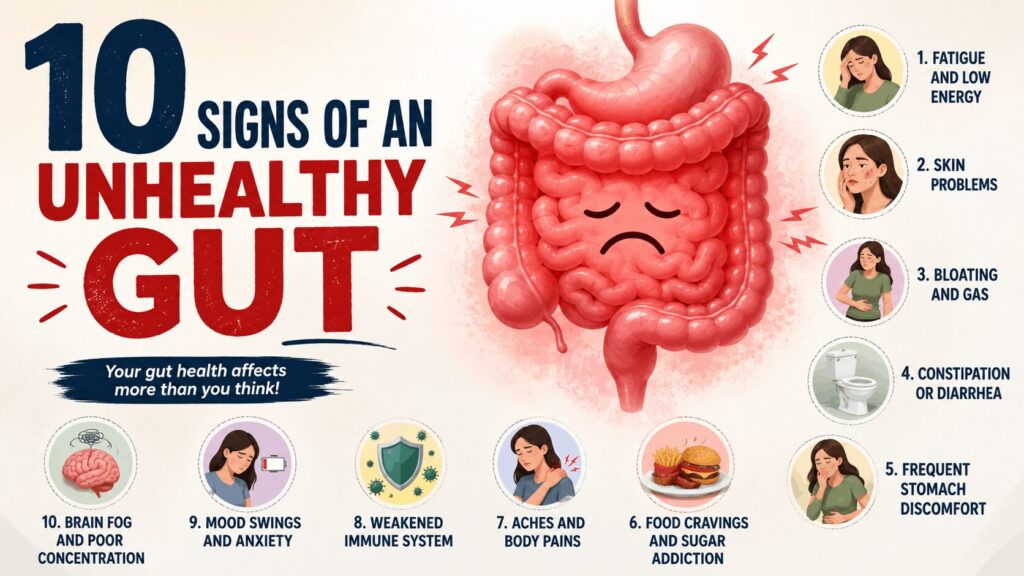
10 Signs of an Unhealthy Gut
1. Frequent Bloating
Feeling bloated after a big meal once in a while is fine. But feeling puffed up after regular meals — or even just water is not normal.
Bloating happens when too much gas builds up in the stomach or intestines. When gut bacteria are out of balance, food does not break down properly. It starts to ferment inside the gut. This produces gas and causes that uncomfortable tightness in your belly.
Processed foods, overeating, and eating too fast can all trigger bloating. But if it happens almost every day, the root cause is usually the gut itself.
I remember a reader who messaged me saying she had been bloated every single day for over three years. She thought it was just her body type.
It was not, She cut out ultra-processed snacks, added more vegetables and fiber, and the bloating reduced within five to six weeks. Simple changes. Big difference.
2. Constant Gas or Indigestion
Some gas is completely normal. In fact, the average adult passes gas around 13 to 21 times a day. But if you are burping frequently, feeling a burning sensation after meals, or dealing with excessive gas that causes embarrassment or pain your digestion is likely struggling.
A weak gut microbiome reduces the body’s ability to produce enough digestive enzymes. Without these enzymes, food stays in the intestines longer than it should. This feeds the wrong type of bacteria and creates more gas and discomfort.
Eating slowly helps. Avoiding sodas and carbonated drinks helps too. But if the problem keeps coming back, focus on rebalancing your gut bacteria that is the real fix.
3. Irregular Bowel Movements
A healthy gut means going to the toilet regularly. Most people go once or twice a day, and the pattern stays consistent.
If you deal with constipation which means fewer than three bowel movements in a week — your gut is likely sluggish.
If you have loose stools often, or your digestion swings between the two without warning, that is also a sign something is off.
Good bacteria in the gut produce compounds called short-chain fatty acids. These keep the gut lining healthy and help food move through at the right speed.
When this process gets disturbed, the whole rhythm of your digestion goes wrong.
If irregular bowel movements have become your normal, they do not have to be. The gut can heal.
4. Feeling Tired All the Time
Do you sleep 7–8 hours and still wake up tired? Does your energy crash in the middle of the day? This could be your gut talking.
Your gut absorbs nutrients from every meal you eat things like iron, vitamin B12, and magnesium. Your body needs these to produce energy.
When your gut is unhealthy, it absorbs far less of what you eat. You can eat a balanced diet and still run low on key nutrients.
A 2025 review in Frontiers in Microbiology confirmed that gut imbalance can reduce the body’s ability to convert food into usable energy. If tiredness is a daily thing for you and no one has checked your gut health, it is worth looking into.
5. Skin Problems
This one always surprises people. Acne, dry patches, redness, or skin that just looks dull these can all be linked to what is happening inside your gut.
Scientists call this connection the gut-skin axis. When the gut lining gets weak, inflammatory chemicals can leak into the bloodstream. These travel to the skin and trigger breakouts or irritation.
A 2022 study in the Journal of Investigative Dermatology found that gut bacteria directly regulate skin inflammation through fatty acids produced during digestion. Research published in Cosmoderma (2024) found that people with acne tend to have measurably different gut bacteria compared to those with clear skin.
My cousin the one I mentioned at the start — started eating more fiber, added a small bowl of curd every day, and reduced her packaged food intake.
Her skin improved more in six weeks than it had in two years of buying skincare products. The fix was inside, not outside.
6. Food Intolerances
A food intolerance is different from a food allergy. An allergy is an immune reaction. An intolerance means your digestive system simply struggles to break down certain foods — dairy, gluten, spicy meals, or high-fat items.
The result is usually bloating, gas, stomach pain, or loose stools after eating that food.
Many people develop intolerances slowly, over years of poor gut health. Foods that never bothered you at age 25 can start causing trouble at 35.
This is because the good bacteria that help digest these foods have reduced over time. If your stomach has started reacting to things it once tolerated, your gut microbiome has likely changed.
7. Trouble Sleeping
Your gut and your sleep are deeply connected — most people just do not know it.
Here is why: the gut produces around 90% of the body’s serotonin. Serotonin is a chemical that controls mood and also helps produce melatonin — the hormone that tells your body it is time to sleep.
A 2024 study in Food Science & Nutrition (Wiley) confirmed that specific gut cells produce serotonin, which then communicates sleep signals to the brain.
When gut health drops, serotonin production drops with it. Melatonin gets affected. And suddenly you are lying awake at night for no obvious reason.
If your sleep quality has been poor for a while, and no one has connected it to your gut health — now you have a new angle to explore.
8. Sugar Cravings
This one is a bit sneaky. Harmful bacteria in the gut — like Candida — feed on sugar. When they grow in large numbers, they can actually influence what you want to eat. They send signals that push you toward sweets, biscuits, and processed snacks.
The more sugar you eat, the more these bacteria grow. The more they grow, the stronger your cravings become. It becomes a cycle that is hard to break.
A major 2025 study published in Nature, covering over 34,000 people in the US and UK, found that those who ate more ultra-processed food consistently had higher levels of harmful gut bacteria.
If your sweet cravings feel out of control, your gut bacteria may literally be driving them.
9. Mood Changes or Brain Fog
Do you feel low without a clear reason? Do you sit down to work and find it hard to focus? Do simple tasks feel mentally heavy?
This is often called “brain fog” — and it is more common among people with gut issues than most people realize.
The gut and the brain are directly connected through a communication pathway called the gut-brain axis.
A 2025 study published in Translational Psychiatry found that gut bacteria influence mood, thinking, and even the risk of conditions like depression and anxiety.
When gut bacteria drop in number or quality, the gut produces less serotonin and related chemicals. Stanford Medicine research (2025) confirms that the brain receives fewer positive signals from the gut — and mood and mental clarity suffer as a result.
If you feel mentally off and cannot figure out why, your gut is worth checking.
10. Frequent Stomach Discomfort
Stomach cramps. A heavy feeling after meals. General unease in your belly that comes and goes. These are easy to ignore when they are mild. But when they show up almost daily, they are telling you something.
This kind of recurring discomfort often points to inflammation in the gut lining, slow digestion, or an overgrowth of the wrong bacteria. It is the gut’s most basic way of saying: something needs to change.
Do not normalize daily stomach discomfort. It is not just how your stomach is. It is a signal.
What Causes Poor Gut Health?
Now that you know the signs, here are the main reasons why the gut gets out of balance:
Too much processed food — Packaged snacks, instant noodles, fast food — these feed harmful bacteria and starve the good ones. The 2025 ZOE/Nature study confirmed this clearly across 34,000 participants.
Excess sugar — Sugar is fuel for harmful bacteria. The more you eat, the more they grow.
Chronic stress — Stress hormones like cortisol directly affect gut bacteria and slow digestion. The gut-brain axis runs both ways. A stressed mind creates a stressed gut.
Poor sleep — Sleep deprivation disrupts the body’s internal clock, which also regulates gut bacteria activity. Research in Frontiers in Psychiatry (2025) confirmed the direct link between sleep disruption and gut microbiome imbalance.
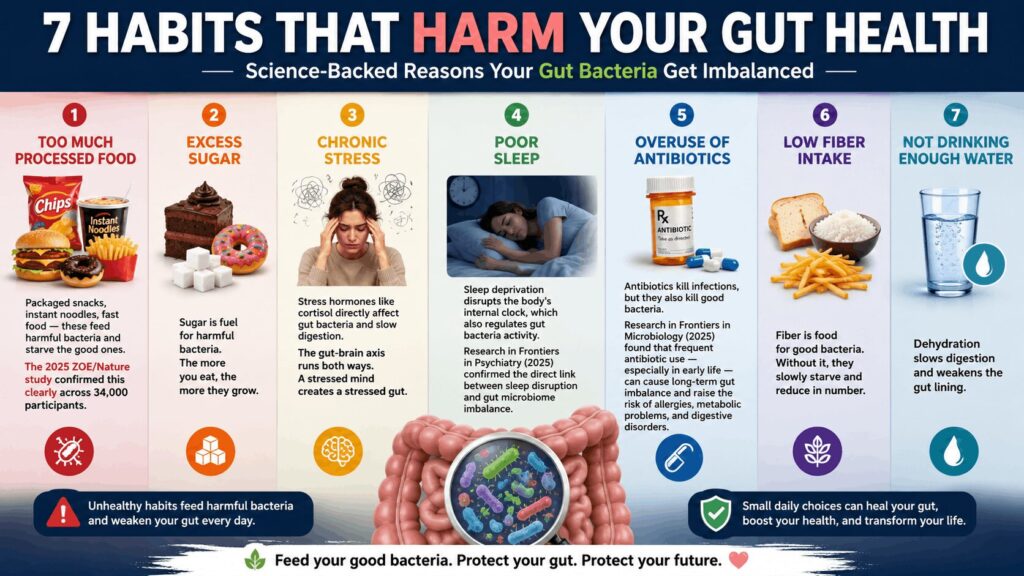
Overuse of antibiotics — Antibiotics kill infections, but they also kill good bacteria. Research in Frontiers in Microbiology (2025) found that frequent antibiotic use — especially in early life — can cause long-term gut imbalance and raise the risk of allergies, metabolic problems, and digestive disorders.
Low fiber intake — Fiber is food for good bacteria. Without it, they slowly starve and reduce in number.
Not drinking enough water — Dehydration slows digestion and weakens the gut lining.
Simple Ways to Improve Gut Health Naturally
Small daily habits can gradually improve gut health. You do not need to change everything overnight. Here is where to start:
Eat More Fiber
Fiber is the single most important food for your gut bacteria. Eat more fruits, vegetables, oats, dal, rajma, flaxseeds, and whole grains. The 2025 Gut Microbiota for Health annual report noted that even the type of gut bacteria you have determines how well your body uses fiber — another reason to eat a variety of plant foods, not just one or two.
Drink Enough Water
Drink at least 8 glasses of water a day. Water keeps your gut moving, protects the gut lining, and helps nutrients absorb properly. It is the cheapest gut health step available.
Cut Back on Processed Foods
You do not have to eat perfectly. Just reduce how often packaged, fried, or ultra-processed food appears on your plate. Replacing two or three junk meals a week with home-cooked food is a real start.
Add Fermented Foods
Dahi (yogurt), kefir, kanji, kimchi, and homemade pickles all contain live bacteria that support the gut. Research in Cosmoderma (2024) and multiple gut health reviews confirm that regular fermented food intake helps restore bacterial diversity after it has been damaged.
Fix Your Sleep Routine
Go to sleep and wake up at the same time each day. Keep your phone away from the bed. A dark, cool room helps you sleep deeper. Better sleep directly supports better gut health — and vice versa.
Manage Stress Every Day
Even 10 minutes of walking, five minutes of slow breathing, or writing in a journal before bed can lower stress hormones. The gut responds to how calm or stressed your nervous system is — not just to what you eat.
Move Your Body Regularly
Exercise increases the variety of bacteria in your gut. You do not have to go to the gym. A 30-minute walk five times a week is enough to make a measurable difference in your gut microbiome over time.
When Should You See a Doctor?
Lifestyle changes work for most gut issues. But some symptoms need a doctor’s attention right away.
Go see a doctor if you notice: severe stomach pain that does not go away, blood in your stool, unexplained weight loss, persistent vomiting, or digestive problems that have lasted more than a few weeks with no improvement.
These can be signs of conditions like irritable bowel syndrome, inflammatory bowel disease, or celiac disease. These need proper diagnosis not just diet changes. Do not delay if any of these apply to you.
Conclusion
Your gut does a lot more than digest food. It affects your energy, your skin, your sleep, your mood, and your ability to focus. Most people have no idea how much of their daily wellbeing is connected to what is happening inside their gut.
The good news is that the gut can heal. Research shows that consistent diet and lifestyle changes can shift the gut microbiome in as little as two to four weeks. You do not need expensive supplements or extreme cleanses.
Improving gut health often starts with simple everyday habits. Eat more fiber. Drink more water. Sleep on time. Manage your stress. Add some fermented food to your daily meals. Start small. Stay consistent.
Your gut has been working hard for you. It is time to return the favour.