
Let me be straight with you. I have been writing about food and health for ten years now. And for a long time, I thought I am eating Healthy Food.
Dal chawal at home, the occasional burger on weekends, nothing extreme. But when I got a routine checkup in 2025, my doctor flagged my triglycerides and told me my gut health looked concerning.
Some foods I was eating almost daily were listed in study after study as major drivers of heart disease, diabetes, and even cancer. I thought I was being mostly healthy. I wasn’t.
This blog is what I wish I had read back then. No scare tactics. No fad diet nonsense. Just honest, research-backed information, including the most current 2025 and 2026 findings about which foods are doing real damage, and what you can do instead.
What you’ll find here: Why certain foods harm the body, the 15 worst offenders named by current research, what happens when you eat them regularly, and realistic swaps you can start making this week.
What Makes a Food Unhealthy?
Not every junk food is equally damaging. The worst ones tend to combine several harmful elements at once.
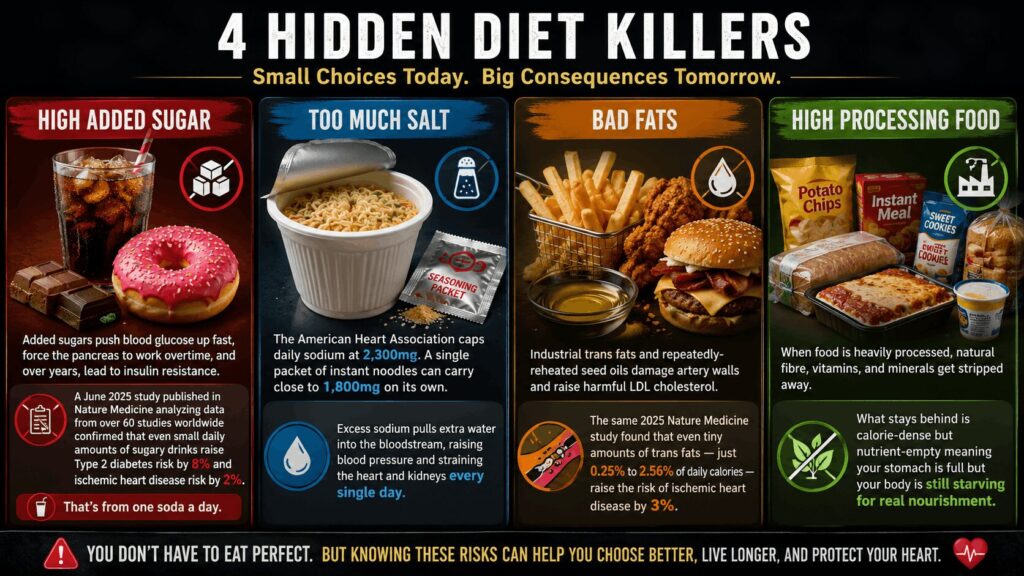
High Added Sugar
Added sugars push blood glucose up fast, force the pancreas to work overtime, and over years, lead to insulin resistance.
A June 2025 study published in Nature Medicine analyzing data from over 60 studies worldwide confirmed that even small daily amounts of sugary drinks raise Type 2 diabetes risk by 8% and ischemic heart disease risk by 2%. That’s from one soda a day.
Too Much Salt
The American Heart Association caps daily sodium at 2,300mg. A single packet of instant noodles can carry close to 1,800mg on its own.
Excess sodium pulls extra water into the bloodstream, raising blood pressure and straining the heart and kidneys every single day.
Bad Fats
Industrial trans fats and repeatedly-reheated seed oils damage artery walls and raise harmful LDL cholesterol.
The same 2025 Nature Medicine study found that even tiny amounts of trans fats — just 0.25% to 2.56% of daily calories — raise the risk of ischemic heart disease by 3%.
High Processing Food
When food is heavily processed, natural fibre, vitamins, and minerals get stripped away. What stays behind is calorie-dense but nutrient-empty meaning your stomach is full but your body is still starving for real nourishment.
According to a May 2026 report by Healthy Eating Research, more than 50% of daily calories eaten by American adults now come from ultra-processed foods, and that figure climbs even higher for children.
My Experience: The label-reading habit changed everything for me. The first time I flipped over a packet of my favourite multigrain crackers and found 680mg of sodium and 8g of added sugar per serving, I nearly put them back right there in the store. I bought them anyway that day — old habits. But I stopped buying them the following week.
15 Worst Foods to Eat for Your Health
These aren’t foods that are bad because of one ingredient. They’re on this list because of the consistent, documented damage they cause when eaten regularly and the science from 2025 and 2026 is more alarming than ever.
1. Sugary Soft Drinks
A can of cola holds about 39g of added sugar — already past most adults’ daily recommended limit. The 2025 Nature Medicine study (IHME, University of Washington), which analyzed data from over 60.
Global studies, found that drinking just one 12-ounce soda per day raises Type 2 diabetes risk by 8% and ischemic heart disease risk by 2%.
The liquid calories bypass hunger signals entirely — your brain doesn’t register them as food, so you’re still hungry an hour later.
2. Packaged Chips and Snacks
Most commercial chips are built around refined starch, seed oil fried at high heat, and sodium levels hitting 400–500mg per small serving.
They’re engineered in labs — the exact ratio of salt, fat, and crunch is calibrated to keep you eating past the point you’re full.
A November 2025 Lancet series written by more than 40 senior health experts identified packaged snacks as a leading contributor to the global chronic disease burden. It’s not a willpower failure. The product is designed to override it.
3. Processed Meats
This one now has some of the strongest evidence against it. A landmark study published in Nature Medicine in June 2025 by IHME researchers analyzing 60+ previous studies involving millions of participants found that eating even one hot dog per day raises.
Type 2 diabetes risk by 11% and colorectal cancer risk by 7%. CNN quoted lead author Dr. Demewoz Haile: there is no safe amount of processed meat to eat habitually.
The WHO has classified processed meat as a Group 1 carcinogen for years. The 2025 data now backs that up with dose-response precision.
4. Instant Noodles
A single packet of instant noodles can carry up to 1,800mg of sodium — nearly 80% of your daily limit in one meal — plus palm oil, refined flour, and flavour packets loaded with additives.
There’s almost no fibre, no real protein, and no meaningful micronutrients. The November 2025 Lancet series flagged that ultra-processed foods like instant noodles are a leading contributor to chronic disease globally, with the poorest populations most at risk because these foods have become dietary staples.
5. Fast Food Burgers
A double-patty fast food burger can hit 900–1,200 calories, 18g of saturated fat, and over 1,200mg of sodium.
Add fries and a soda and you’ve blown past most people’s entire daily limit in one sitting. A December 2025 study tracking over 63,000 adults found that high-quality, minimally processed plant foods.
Significantly cut cardiovascular risk — while ultra-processed versions of those same foods wiped out every benefit. The contrast with fast food is stark.
6. Sugary Breakfast Cereals
Walk down any cereal aisle and you’ll find boxes labelled whole grain or fortified. Flip them over and you’ll often find 10–18g of added sugar per serving — more than some cookies.
The grain has been refined and stripped of natural fibre, then synthetic vitamins are sprayed back on.
The November 2025 Lancet series specifically named highly processed bread and breakfast food as one of the food categories linked to higher colorectal cancer risk in younger women.
7. Candy and Sweets
Candy delivers concentrated sugar with zero nutritional value. The fructose in corn syrup the backbone of most commercial candy is processed almost entirely by the liver.
Too much over time leads to fat buildup in the liver, elevated triglycerides, and non-alcoholic fatty liver disease.
The 2025 IHME Nature Medicine study confirmed that the risk from sugary foods starts at even very low consumption levels there’s no “safe” threshold below which the body is unaffected.
8. Deep-Fried Foods
Frying at high heat creates harmful compounds including acrylamide and advanced glycation end-products (AGEs), both of which drive cellular damage and chronic inflammation.
A May 2025 study found that people who eat more ultra-processed foods — including fried items like hot dogs and processed snacks are more likely to show early signs of Parkinson’s disease compared to those who eat very few.
Researchers from Fudan University and Harvard School of Public Health led that study.
9. Energy Drinks
One 250ml energy drink typically packs 80mg of caffeine and 27g of sugar. Larger cans double both. Caffeine raises cortisol; sugar raises insulin — both happening at the same time, repeatedly, puts real strain on the cardiovascular and adrenal systems.
The July 2025 USDA and FDA joint initiative on ultra-processed foods specifically flagged energy drinks as a category requiring urgent regulatory attention, under a federal effort accelerated in 2025 to address diet-related chronic disease.
10. White Bread
White flour is what’s left after the bran and germ — the nutritious parts — are removed. What remains is almost pure starch with a glycemic index close to pure glucose.
The April 2026 paper published in npj Metabolic Health and Disease notes that high-energy-density foods with disrupted food matrices — white bread being a prime example — promote faster eating, excess energy intake, and weight gain. Over years, this cycle erodes insulin sensitivity.
11. Packaged Cookies and Cakes
Factory-made baked goods combine refined flour, added sugar, and palm oil or partially hydrogenated oils in one package.
They also contain preservatives that extend shelf life for months — something no naturally made food can do.
A November 2025 study published in JAMA Oncology — analyzing nearly 30,000 women over two decades — found that women with the highest ultra-processed food intake, which includes packaged baked goods, had a 45% higher risk of developing adenomas (precancerous colon polyps) before age 50.
12. Ice Cream
A two-scoop serving of commercial ice cream often carries 30–40g of sugar and 10–15g of saturated fat. Had occasionally, it’s a treat.
The problem is when it becomes a daily habit. The April 2026 review in npj Metabolic Health and Disease confirms that high UPF exposure — including dairy desserts — is linked to increased obesity.
Type 2 diabetes, and cardiovascular disease risk. The sugar-fat combination in commercial ice cream is particularly effective at training the brain’s reward system to keep wanting more.
13. Frozen Processed Meals
Even “healthy” branded frozen meals routinely carry 700–1,100mg of sodium per serving, kept stable with stabilisers, modified starch, and preservatives.
The November 2025 Lancet series — involving over 40 leading global health experts — described ultra-processed ready meals as one of the biggest food policy failures of the modern era, recommending that governments ban UPFs in schools and hospitals and cap their shelf space in supermarkets as a matter of public health urgency.
14. Sweetened Coffee Drinks
A large flavoured frappuccino or sweetened iced coffee from a café chain can hold 50–70g of sugar — more than two cans of cola.
Most people don’t count these as food, which makes them invisible calories in the diet. The 2025 Nature Medicine study reinforces that sugary beverages of all kinds — including sweetened coffee drinks — carry the same risk profile as soda: elevated diabetes and heart disease risk even at low, daily consumption levels.
15. Processed Cheese Products
Processed cheese slices and spreads are not real cheese — they are cheese products made from a small base of dairy blended with emulsifying salts, vegetable oils, food starch, and artificial flavours.
The 2026 npj Metabolic Health and Disease review notes that emulsifiers — heavily used in processed cheese products — may adversely affect gut health by disrupting the microbiome. High sodium levels add further cardiovascular strain.
My Experience: I used to start every morning with a large sweetened caramel latte. It felt like fuel. When I actually looked it up, that one drink had 54g of sugar — before I’d eaten anything.
I switched to black coffee with a splash of oat milk. The first week was rough. By week three, I didn’t miss the sweet one at all.
And my afternoon energy crash, which I’d assumed was just how I was built, basically disappeared.
Why These Foods Are Harmful When Eaten Regularly
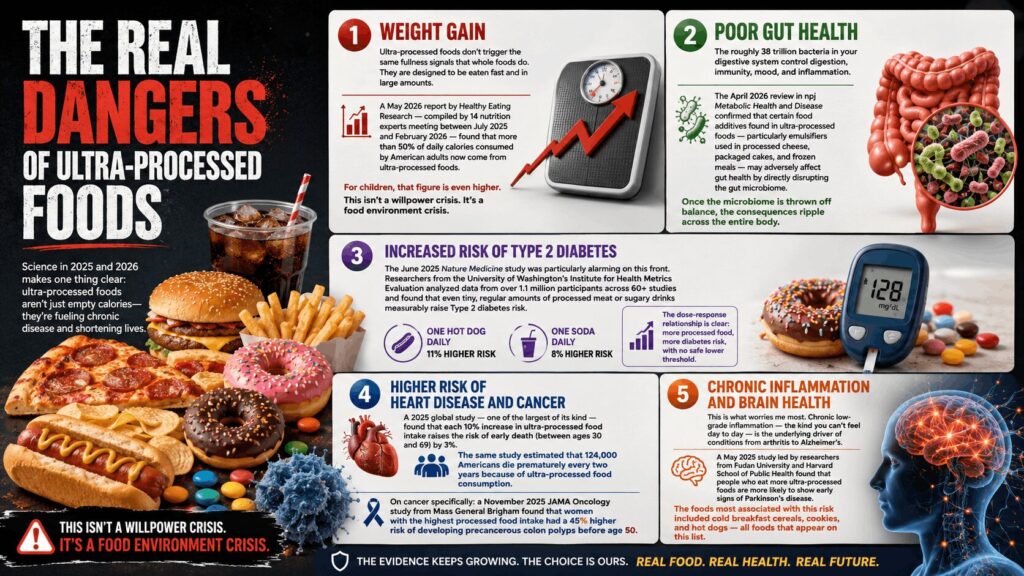
Weight Gain
Ultra-processed foods don’t trigger the same fullness signals that whole foods do. They are designed to be eaten fast and in large amounts.
A May 2026 report by Healthy Eating Research — compiled by 14 nutrition experts meeting between July 2025 and February 2026 — found that more than 50% of daily calories consumed by American adults now come from ultra-processed foods.
For children, that figure is even higher. This isn’t a willpower crisis. It’s a food environment crisis.
Poor Gut Health
The roughly 38 trillion bacteria in your digestive system control digestion, immunity, mood, and inflammation.
The April 2026 review in npj Metabolic Health and Disease confirmed that certain food additives found in ultra-processed foods — particularly emulsifiers used in processed cheese, packaged cakes, and frozen meals — may adversely affect gut health by directly disrupting the gut microbiome.
Once the microbiome is thrown off balance, the consequences ripple across the entire body.
Increased Risk of Type 2 Diabetes
The June 2025 Nature Medicine study was particularly alarming on this front. Researchers from the University of Washington’s Institute for Health Metrics.
Evaluation analyzed data from over 1.1 million participants across 60+ studies and found that even tiny, regular amounts of processed meat or sugary drinks measurably raise Type 2 diabetes risk.
One hot dog daily — 11% higher risk. One soda daily — 8% higher risk. The dose-response relationship is clear: more processed food, more diabetes risk, with no safe lower threshold.
Higher Risk of Heart Disease and Cancer
A 2025 global study — one of the largest of its kind — found that each 10% increase in ultra-processed food intake raises the risk of early death (between ages 30 and 69) by 3%.
The same study estimated that 124,000 Americans die prematurely every two years because of ultra-processed food consumption.
On cancer specifically: a November 2025 JAMA Oncology study from Mass General Brigham found that women with the highest processed food intake had a 45% higher risk of developing precancerous colon polyps before age 50.
Chronic Inflammation and Brain Health
This is what worries me most. Chronic low-grade inflammation — the kind you can’t feel day to day — is the underlying driver of conditions from arthritis to Alzheimer’s.
A May 2025 study led by researchers from Fudan University and Harvard School of Public Health found that people who eat more ultra-processed foods are more likely to show early signs of Parkinson’s disease.
The foods most associated with this risk included cold breakfast cereals, cookies, and hot dogs — all foods that appear on this list.
My Experience: When my triglyceride results came back high in 2021, my doctor asked what I ate for snacks. Chips, biscuits, energy drinks in the afternoon.
She wrote four things: cut the drinks, drop the chips, add a handful of nuts, add more vegetables. No medication.
Four months later, my numbers were back in normal range. I genuinely hadn’t believed food could move those numbers that fast.
Healthier Alternatives to Unhealthy Foods
Nobody quits bad food through willpower alone. What works is having something better ready to reach for.
| Instead of… | Try This Instead | Why It Works |
|---|---|---|
| Sugary soft drinks | Water with lemon and mint | Zero added sugar; makes plain water feel refreshing |
| Packaged chips | Roasted chickpeas or almonds | Same crunch, with protein and fibre |
| Candy | Fresh fruit with peanut butter | Natural sugars come with fibre that slows absorption |
| White bread | Whole-grain or sourdough bread | Higher fibre keeps blood sugar stable for longer |
| Ice cream | Greek yogurt with berries | High protein, gut-friendly probiotics, naturally sweet |
| Instant noodles | Homemade vegetable soup | 20 minutes to make, costs less, far less sodium |
| Sweetened coffee drinks | Black coffee or unsweetened oat milk latte | Cuts 50–70g of daily sugar in one switch |
| Processed cheese | Real cheddar, paneer, or cottage cheese | Actual dairy with real protein; no emulsifying salts |
Tips to Reduce Unhealthy Foods in Your Diet
Read the Label Before You Buy, Not After
Check sodium per 100g — not just per serving. Manufacturers love small serving sizes to make numbers look better.
Look for added sugars hiding under names like dextrose, maltose, corn syrup, or evaporated cane juice.
The May 2026 Healthy Eating Research report also recommends checking for additive markers — colours, flavours, emulsifiers — as red flags on any label.
Cook Three Dinners a Week at Home
Start small. Three home-cooked dinners a week can significantly cut weekly sodium intake because home food uses 40–50% less salt than restaurant and packaged food. You control the oil, the sugar, and the ingredients entirely.
Build Meals Around Whole Foods First
Start the plate with vegetables, whole grains, or legumes — then add everything else. Dal, rajma, eggs, brown rice, seasonal sabzi.
The closer a food is to how it came out of the ground, the better your body recognises it as actual nourishment.
The December 2025 study tracking 63,000 adults confirmed that minimally processed plant foods significantly reduce cardiovascular risk — but only when they stay minimally processed.
Drop One Sugary Drink Per Day
The 2025 Nature Medicine research makes this the single clearest, most evidence-backed dietary change anyone can make.
Removing one sugary drink per day reduces measurable Type 2 diabetes and heart disease risk. One drink. Start there.
Set Up Your Snacks Before You’re Hungry
Nobody makes good food choices when they’re already hungry and staring at an empty fridge. Keep almonds in your bag. Put hard-boiled eggs on the top shelf.
Cut fruit in the morning so it’s ready by afternoon. The July 2025 FDA and USDA joint initiative on UPFs specifically highlighted the need to improve food literacy and equitable access — because when healthy food is the most convenient option, people naturally choose it.
My Experience: The pre-cut fruit trick sounds too simple to matter. It isn’t. When I started keeping a container of chopped mango or papaya in the fridge, I reached for it at 4pm instead of biscuits — not because I was disciplined, but because it was already there. Half the battle with healthy eating is just removing the steps between you and the good option.
The Bottom Line
None of the 15 foods on this list will ruin your health if eaten once in a while. The damage is in the daily habit.
A diet built around sugary drinks, instant noodles, processed meats, and packaged snacks — eaten day after day — creates a slow, compounding burden on your heart, gut, liver, and metabolism.
The 2025 science makes this harder to ignore than ever. A global study found that 124,000 Americans die prematurely every two years because of ultra-processed food consumption.
The 2025 Nature Medicine research says there is no safe amount of processed meat. Mass General Brigham researchers found that heavy processed food intake raises precancerous colon polyp risk by 45% in women under 50.
And a 2025 Harvard-linked study connected ultra-processed food consumption to early signs of Parkinson’s disease.
This is not about being perfect. Pick one food from this list that you eat the most. Find one swap you can live with.
Do it for a month. Then pick the next one. Small, consistent changes show up in your blood work, your energy levels, and how you feel getting out of bed each morning.
I didn’t fix my health by becoming obsessive about food. I fixed it by paying attention — one label, one swap, one meal at a time. You can do the same.