
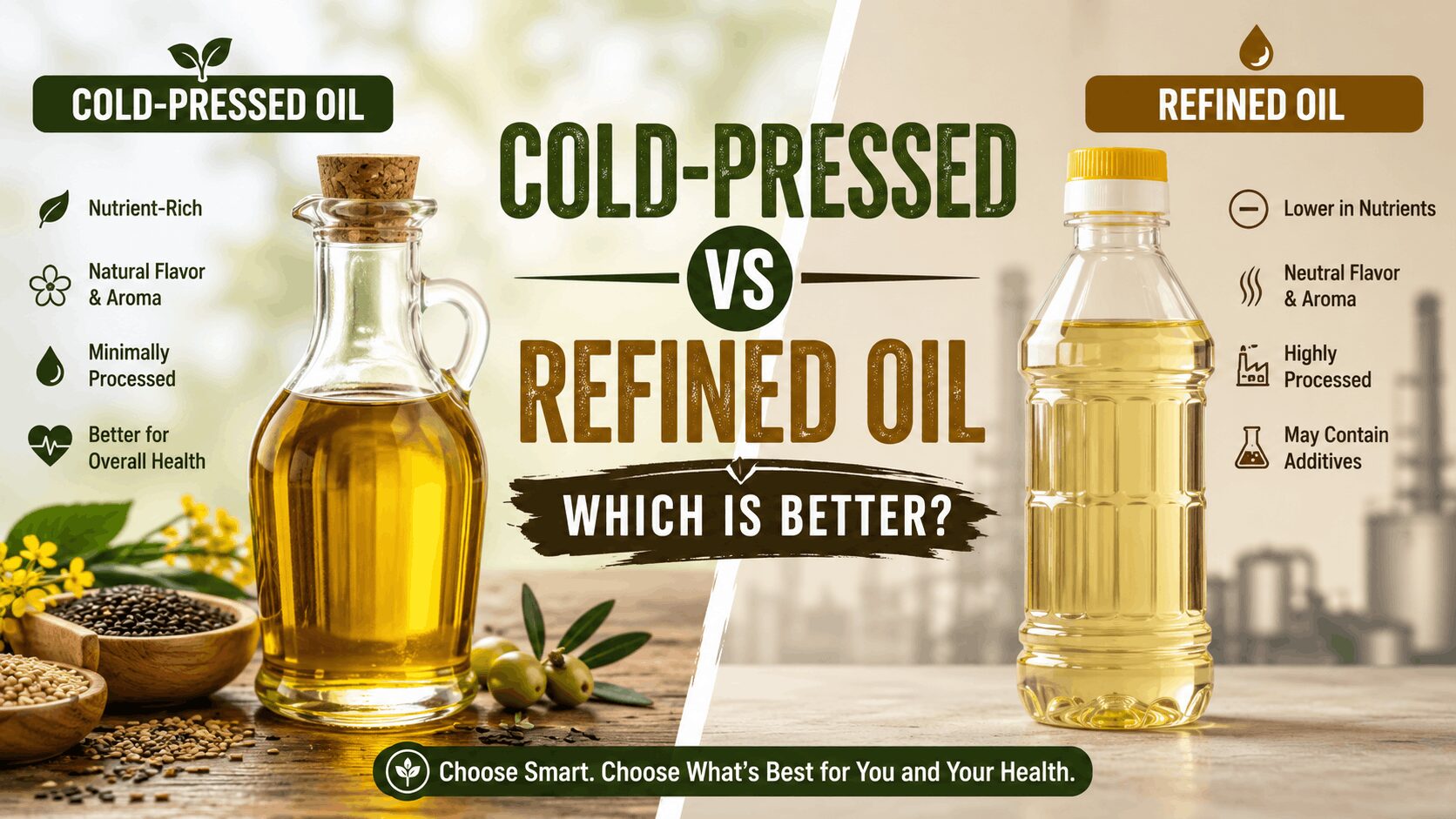
My grandmother used to say one thing about oil that stuck with me for years. The one that gives you smell, that’s the real one. I didn’t fully get it until I started reading labels myself.
Walk into any store today and you’ll see two completely different worlds sitting on the same shelf. Shiny refined oil bottles with bold heart healthy claims on one side.
Cloudy, golden cold-pressed or kachi ghani bottles on the other, priced almost double, sometimes more.
If You Read other blog about healthiest cooking oil in India
So which one actually deserves a spot in your kitchen?
I switched from refined sunflower oil to cold-pressed groundnut oil about three years back, mostly out of curiosity, not some big health mission.
The taste difference hit me on day one. My grocery bill noticed too. Here’s everything I learned along the way, minus the marketing fluff most articles repeat.
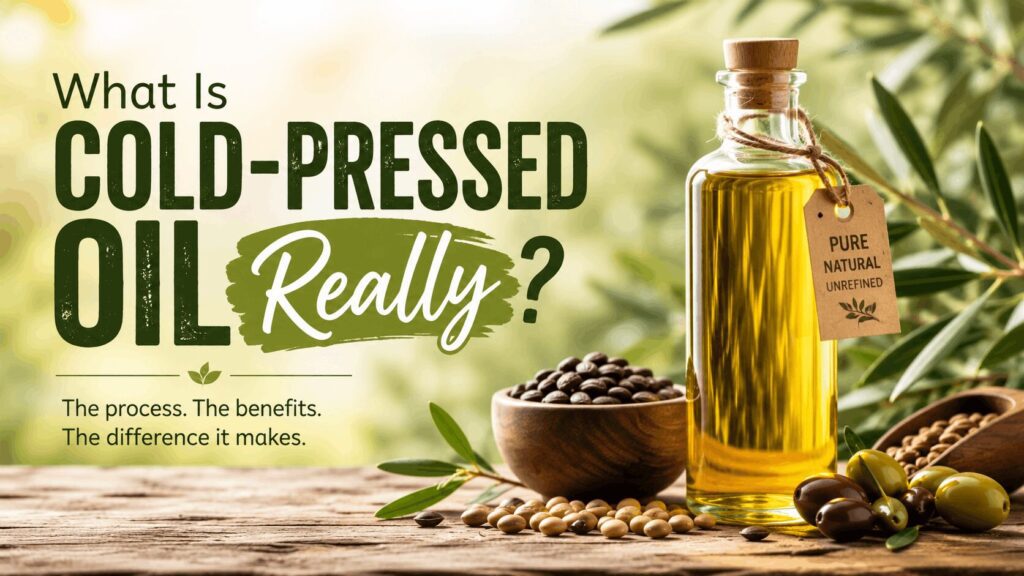
What Is Cold-Pressed Oil Really?
Cold-pressed oil comes from mechanically crushing seeds or nuts at low temperatures — usually under 50°C. No chemicals involved. No bleaching. No deodorizing.
It’s basically the difference between squeezing an orange by hand versus running it through an industrial juicer. You get less juice this way, sure, but it tastes a lot closer to the actual fruit.
Seeds get cleaned first, then fed into a wooden or steel expeller — called a ghani in most parts of India. Slow pressure crushes them, oil comes out, and that’s pretty much it.
Just basic filtering after that, nothing chemical. Color, smell, taste — all of it stays intact because nothing was stripped away in the process.
That’s really the whole selling point here. Less interference, more of the original nutrients survive.
And What About Refined Oil?
Refined oil starts off the same — pressing or solvent extraction from seeds. The difference shows up after that. It goes through degumming, neutralizing, bleaching, and deodorizing before it ever reaches a bottle.
All that processing removes impurities, yes. But it also removes a good chunk of the natural color, smell, and nutrients along with it.
Most refined oils use a solvent called hexane during extraction, followed by high heat to strip away free fatty acids and any leftover smell.
What you’re left with is a clear, almost flavorless oil that can sit on a shelf for over a year without going bad.
There’s a reason restaurants and most households still rely heavily on it — it’s predictable, cheap, and lasts forever compared to its cold-pressed counterpart.
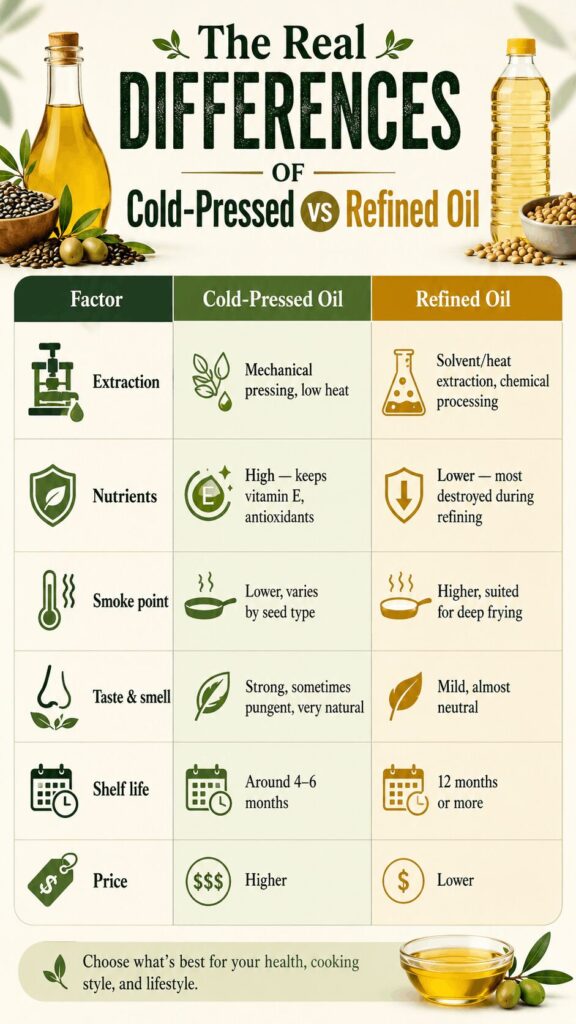
The Real Differences Of Cold-Pressed vs Refined Oil
| Factor | Cold-Pressed Oil | Refined Oil |
|---|---|---|
| Extraction | Mechanical pressing, low heat | Solvent/heat extraction, chemical processing |
| Nutrients | High — keeps vitamin E, antioxidants | Lower — most destroyed during refining |
| Smoke point | Lower, varies by seed type | Higher, suited for deep frying |
| Taste & smell | Strong, sometimes pungent, very natural | Mild, almost neutral |
| Shelf life | Around 4-6 months | 12 months or more |
| Price | Higher | Lower |
Honestly, neither side wins every row here. That’s something most blogs conveniently skip because cold-pressed good, refined bad makes for an easier headline.
Why Cold-Pressed Oil Gets the Health Vote
Cold-pressed oils hold onto natural compounds called tocopherols and polyphenols. These act like built-in antioxidants, and they’re mostly destroyed during the deodorizing stage refined oil goes through.
A few things worth actually knowing, not just hearing:
- Cold-pressed oils keep more of their original monounsaturated and polyunsaturated fat content. Heavy processing during refining can convert some of this into trans fats, which nobody really wants in their diet.
- There’s no solvent residue to worry about. Refined oils made using hexane need to stay under a strict residue limit set by Indian food safety standards — cold-pressed oils skip that step altogether.
- The flavor difference isn’t subtle. Cold-pressed mustard oil has that sharp bite. Cold-pressed coconut oil actually smells like coconut. Refined versions of both end up tasting almost identical to each other, which tells you something got lost somewhere along the way.
Here’s something interesting — India’s food safety regulator (FSSAI) actually requires that any oil labeled Kachi Ghani or Cold Pressed must contain a minimum level of a compound called allyl isothiocyanate.
This rule exists specifically because so many brands were quietly selling refined oil under a cold-pressed label. The fact that a rule like this had to be made tells you how big — and how messy — this market had gotten.
Refined Oil Isn’t the Villain Here
This isn’t meant to be a one-sided takedown of refined oil. It earned its place in kitchens for solid reasons, not just price.
Its higher smoke point makes it genuinely safer for deep frying. Push a cold-pressed oil too hard on high flame and it starts breaking down faster, which can actually create harmful compounds — the opposite of what people are buying it for.
It’s also more budget-friendly for daily, high-volume cooking, more stable in hot and humid kitchens where oil can turn rancid fast, and neutral enough that it doesn’t fight with the flavor of whatever you’re cooking.
If you’re frying samosas all day in a restaurant kitchen, refined oil isn’t some compromise — it’s genuinely the right tool for that job.
Mistakes People Keep Making
I’ve seen the same slip-ups repeated over and over, even by people who switched to cold-pressed oil with good intentions.
Using cold-pressed oil for deep frying is probably the biggest one. Lower smoke point means it breaks down quicker under high heat, and that defeats the entire purpose of buying it in the first place.
Storing it next to the stove is another common mistake. Heat and light degrade those nutrients fast — keep the bottle in a cool, dark cabinet instead.
And then there’s the assumption that “cold-pressed” automatically means premium quality. It doesn’t. Quality varies wildly between brands.
Look for oils that are unfiltered or only lightly filtered, packaged in dark glass or tin (not clear plastic sitting under shop lighting), and made from a single seed source rather than a vague blend.
So Which One Should You Actually Buy?
Depends entirely on how you cook, not on which label sounds healthier.
For salad dressings, dips, or finishing a dish right before serving — go cold-pressed. No heat involved means the flavor and nutrients actually get to shine.
For light sautéing, cold-pressed still works fine at medium heat. For deep frying or anything high-heat, refined oil is the safer, more practical pick.
And if you’re cooking for a large family on a tight budget, refined oil keeps costs manageable without wrecking your diet, as long as the rest of your meals are reasonably balanced.
Most households I know these days keep two bottles, not one. A small bottle of cold-pressed oil for dressings and tempering, a bigger one of refined oil for everyday frying.
Honestly, that combination just makes more sense than picking a side and sticking to it religiously.
Frequently Asked Question
Is cold-pressed oil healthier than refined oil?
In most cases, yes — better nutrient retention, more antioxidants. But “healthier” depends on how you use it too. Deep-frying with cold-pressed oil basically cancels out the benefit you paid extra for.
Can cold-pressed oil be used for everyday cooking?
Yes, for sautéing, tempering, and lighter cooking it works well. Just avoid pushing it to prolonged high-heat frying.
Why does cold-pressed oil cost so much more?
Less oil comes out per batch of seeds, the process is slower, and the shelf life is shorter — all of that adds up in the price tag.
Does refined oil have any nutrition left at all?
Some, but noticeably less than cold-pressed. The refining steps remove most of the natural antioxidants and part of the original fatty acid content along with it.