
Last June, I was working out at 11 in the morning. Temperature outside was around 41°C. I had already had two cups of tea and a glass of water since waking up, so I thought I was fine.
I wasn’t. By the time I got back inside, I had a splitting headache, my hands were shaking, and I felt nauseous. I hadn’t been running a fever. I wasn’t sick. I was just badly dehydrated and I had no idea it had happened so fast.
That day pushed me to actually read the research on summer hydration instead of going off vague advice like drink 8 glasses a day. What I found changed how I manage heat completely.
This guide is everything I’ve learned since the science, the practical schedules, what actually works in Indian summer conditions, and the mistakes most people keep making year after year.
The Real Problem With How Most of Us Drink Water in Summer
Here’s the thing nobody tells you: by the time your body sends a thirst signal, you are already about 1 to 2 percent dehydrated. That sounds small.
It isn’t. At that level, your reaction time drops, your ability to concentrate becomes noticeably worse, and if you’re outdoors in heat, your muscles start giving you early warning signals slight cramps, a bit of fatigue that doesn’t make sense given how little you’ve done.
Most people respond to summer by drinking more water when they feel thirsty. That’s reactive. The body needs you to be ahead of it, not catching up.
Think of it like refuelling a car you don’t wait until the fuel light comes on every single time. You watch the gauge and top up before the warning kicks in.
Summer makes this harder for a few specific reasons. One: the heat isn’t just making you sweat more water you’re also sweating out sodium, potassium, and magnesium with every drop.
Two: air conditioning gives you a false sense of security because you don’t feel hot, but dry AC air still pulls moisture out through your skin and breath.
Three: in high humidity (which is most of India’s coast and northern plains from May to July), sweat doesn’t evaporate properly so your body keeps trying to cool itself and keeps sweating more, without you actually feeling the cooling effect.
A 2026 review published in the journal Nutrients found that during moderate outdoor activity in hot conditions, a person can lose up to 2,000 mg of sodium per hour through sweat alone. That’s not just a water problem. That’s a mineral problem.
How Much Water Do You Actually Need in Summer?
The 8-glasses-a-day rule is outdated and frankly unhelpful. It doesn’t account for your weight, what you’re doing, how hot it is, or whether you’re also getting fluids from food. Here are more grounded starting points:
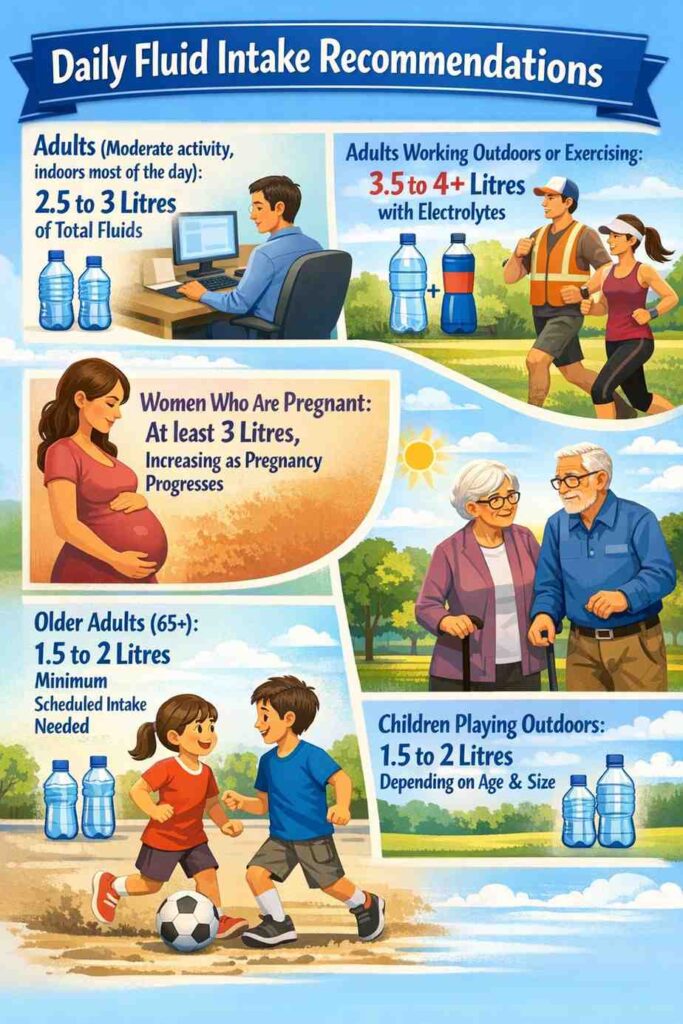
- Adults (moderate activity, indoors most of the day): 2.5 to 3 litres of total fluids
- Adults working outdoors or exercising: 3.5 to 4+ litres, with electrolytes mixed in
- Women who are pregnant: at least 3 litres, increasing as the pregnancy progresses
- Older adults (65+): minimum 1.5 to 2 litres — their thirst signal is unreliable so they need a schedule
- Children playing outdoors: 1.5 to 2 litres depending on age and size
A rough formula I use personally: drink half my body weight in kilograms, expressed in ounces, as a baseline.
Then I add 500 ml for every hour I spend outside when it’s above 35°C. It’s not perfect science but it’s close enough to make a real difference.
One caution don’t go overboard on the other side either. Drinking more than about 1.5 litres in one go or more than 6 cups per hour can dilute your blood sodium to dangerous levels. Slow and steady through the day beats three large glasses all at once.
What Your Urine Color Is Telling You (The Fastest Hydration Check)
This is the one test that’s always available, costs nothing, and tells you exactly where you stand in about two seconds. I check mine every morning and genuinely adjust my day around it.
| Urine Color | What It’s Telling You | What to Do |
| Pale yellow / straw | You are well hydrated — this is the target | Nothing. Keep going. |
| Clear / transparent | You might be slightly over-hydrated | Ease off plain water a bit, add electrolytes |
| Normal yellow | Hydrated — acceptable range | You’re doing well |
| Dark yellow | Your body wants more water — now | Drink 1–2 glasses immediately |
| Amber / orange | Mild to moderate dehydration | Sit in shade, sip steadily, add ORS or nimbu pani |
| Brown / rusty | Severe dehydration or possible medical issue | Stop activity. Hydrate. See a doctor if it persists. |
First morning urine is your report card for the previous day. If it’s darker than normal yellow before you’ve even left the house, you need to prioritise fluids before anything else before chai, before breakfast, before going anywhere.
Signs of Dehydration in Summer What to Actually Watch For
Most lists of dehydration symptoms give you the obvious ones. Here’s what I’ve noticed actually happens in real life, in order:
The early signs people ignore
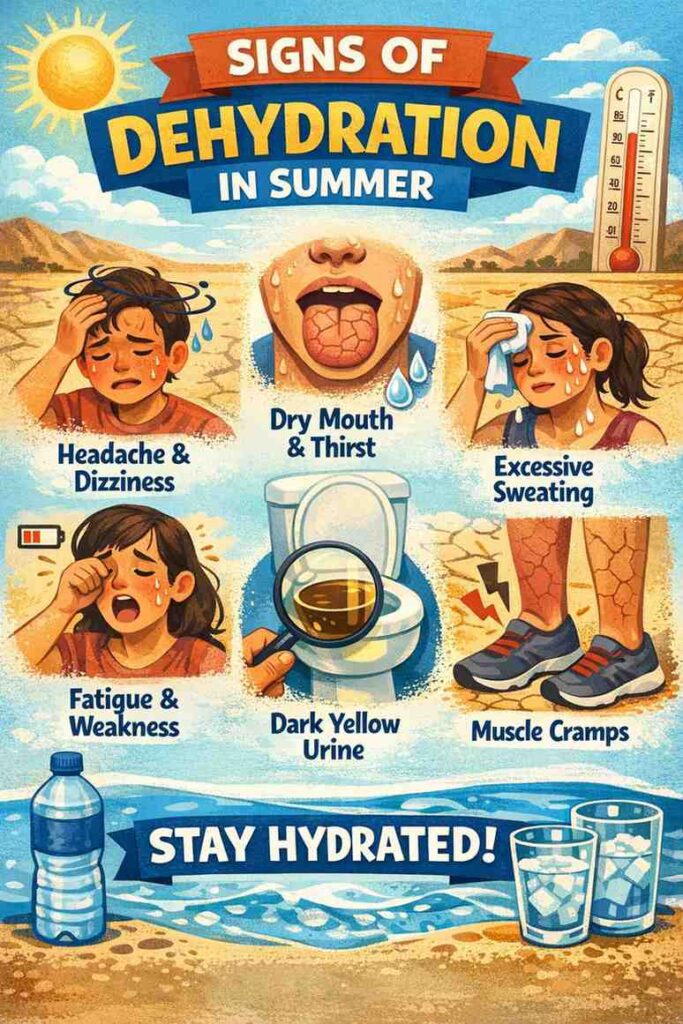
- A low, dull headache that appears in the early afternoon for no obvious reason
- Feeling irritable or losing patience faster than usual
- Difficulty focusing — sentences feel harder to read, small decisions take longer
- Urine that’s darker than usual
- Dry mouth that doesn’t fully go away after drinking
- Fatigue that doesn’t match how much you’ve actually done
Moderate dehydration — this is where most people finally notice
- Strong headache that doesn’t ease with rest
- No urination for 4 or more hours
- Muscle cramps, especially in calves and feet
- Heart rate feels faster than normal even at rest
- Nausea — especially in full sun
- Dizziness when standing up from a seated or lying position
Severe dehydration stop what you’re doing
- Confusion, difficulty thinking clearly
- Eyes look sunken, skin doesn’t spring back when pinched
- No urine for 8+ hours
- Rapid, shallow breathing
- In direct sun with severe dehydration — heat stroke can develop in minutes
Heat stroke is not just bad dehydration. It’s a medical emergency. If someone stops sweating despite being in extreme heat, becomes confused, or loses consciousness get them into shade immediately, pour water over them, and call for help. Don’t give them large amounts of water to drink until they’re conscious and responsive.
Top 20 Hydrating Foods for Summer Including Indian Options That Work Brilliantly
About 20% of your daily fluid intake should come from food, not drinks. On days when I genuinely can’t drink as much as I should busy schedule, traveling, meetings back to back I lean hard on food hydration to close the gap. Here’s what I keep eating through Indian summer:
| Food Item | Water % | Best Way to Have It in Summer |
| Cucumber | 96% | Slice raw, add to water, eat with nimbu and namak |
| Iceberg Lettuce | 96% | Use as wrap base, add to chaas smoothie |
| Celery | 95% | Chew raw, add to salads, dip in hummus |
| Nimbu Pani (lemon water) | 95% | With kala namak + sugar — natural ORS |
| Tomatoes | 94% | Raw in salad, cooked in dal, blended in soup |
| Zucchini | 94% | Grilled, stir-fried, or raw in summer salads |
| Coconut Water | 94% | Chilled, straight from the coconut or packaged |
| Watermelon | 92% | Chilled cubes, blend into sharbat, freeze as popsicle |
| Bell Peppers | 92% | Raw sticks with curd dip, add to sabzi |
| Buttermilk / Chaas | 90% | With roasted jeera, hing, curry leaves — chilled |
| Cantaloupe / Kharbooja | 90% | Chilled, blended with mint and lime |
| Spinach | 91% | Morning smoothie, dal palak, raw in salad |
| Strawberries | 91% | Fresh with curd, frozen in water |
| Peaches / Aadoo | 88% | Fresh and chilled — eat the skin too |
| Plain Dahi (Yogurt) | 88% | With fruit, as raita, as lassi base |
| Aam Panna (raw mango) | 87% | Chilled with jeera, pudina, kala namak |
| Oranges / Mosambi | 87% | Fresh juice without sugar, or eat raw segments |
| Watermelon Rind | 93% | Pickle it, stir-fry with spices — don’t throw it away |
| Sattu Sharbat | 83% | Roasted gram flour, water, lemon, kala namak — Bihari powerhouse |
| Bel Sharbat (Wood Apple) | 85% | Traditional cooling drink — fantastic for digestive health too |
A note on the Indian options in that list — aam panna, chaas, sattu sharbat, and bel sharbat are not just culturally familiar.
They actually work better for Indian summer conditions than most commercial sports drinks. They have the right mix of natural salts, sugars, and cooling compounds that your body needs. Our grandmothers knew what they were doing.
Best Drinks for Summer Hydration — What to Reach For and What to Put Down
Drink more of these
- Plain water — still nothing beats it for basic daily hydration
- Nimbu pani with kala namak and a pinch of sugar — this is a natural ORS and it genuinely works
- Coconut water — best drunk fresh, excellent post-outdoor drink because it has potassium and calcium already in it
- Chaas / buttermilk — cooling, probiotic, and it has the sodium your body is losing through sweat
- Herbal iced teas: hibiscus, peppermint, chamomile — no caffeine, actually cooling
- Infused water: cucumber-mint, watermelon-lime, lemon-ginger — much easier to drink consistently than plain water
- ORS sachets dissolved in water — massively underrated for summer use, not just for illness
Put these down or at least slow down on them
- Alcohol — it forces your kidneys to produce more urine than the liquid you drank, so you end the session more dehydrated than when you started
- Cold sugary sodas — the sugar pulls water out of your cells, the caffeine mildly increases urine output
- Packaged fruit juices — most are water + sugar + flavour with very little actual fruit
- More than 2–3 cups of coffee or strong tea in a day — in moderation it’s fine, but I’ve noticed my urine gets darker on high-chai days in summer
- Energy drinks — high caffeine and sugar in one shot, terrible for actual hydration
DIY Electrolyte Drink Recipes I Actually Use
I started making these after realising that most commercial electrolyte drinks either taste like chemicals or have more sugar than they need. These are simple, cheap, and work.
Recipe 1 The Classic Nimbu ORS (What I Drink After Any Outdoor Session)
- 250 ml room temperature water
- Juice of half a lemon
- 1/4 teaspoon salt (plain or kala namak)
- 1 teaspoon sugar or honey
- Optional: tiny pinch of jeera powder for digestion
Mix and drink. This is nearly identical in mineral content to a commercial ORS sachet. My doctor confirmed this when I asked her about it. The ratio matters — don’t add more salt thinking it’ll help faster. It won’t.
Recipe 2 Coconut Water Boost (Post-Exercise Favourite)
- 200 ml fresh or packaged coconut water
- Juice of half a lime
- 1/8 teaspoon rock salt or Himalayan salt
- 4–5 crushed mint leaves
Shake or stir. Coconut water already has potassium, magnesium, and calcium in it, so this drink handles most of what you lose in an hour of outdoor exercise without needing any supplements.
Recipe 3 Watermelon-Mint Sharbat (The One I Make on Saturdays)
- 2 cups blended and strained watermelon juice
- Juice of 1 lime
- 1/4 teaspoon kala namak
- Handful of fresh pudina (mint)
- 150 ml cold water
Blend everything, strain, drink cold. Watermelon is 92% water and has lycopene and Vitamin C on top of that. On a 44°C afternoon this thing genuinely makes a difference in how you feel within 20 minutes.
Your Daily Summer Hydration Schedule Built Around How We Actually Live
I’ve tried drink-when-thirsty. It doesn’t work in summer. I’ve tried vague “drink more” advice. Also doesn’t work. What actually works is a schedule that you follow regardless of thirst. Once it becomes habit it takes zero mental effort.
| Time | How Much to Drink | Notes |
| First thing in the morning (6–7 AM) | 300–400 ml | Your body dried out overnight. This is the most important glass of the day. |
| Breakfast to mid-morning (7–10 AM) | 400–500 ml | Before heat sets in. Start early, not after. |
| Mid-morning (10 AM – 12 PM) | 300–400 ml | Temperatures are rising. Keep sipping — don’t wait to feel thirsty. |
| Afternoon (12 PM – 4 PM) | 500–700 ml | Peak heat window. Highest sweat loss. This slot is where most people fall short. |
| Evening (4–7 PM) | 400–500 ml | Recovery window after the hottest hours. |
| Night (7 PM to bedtime) | 200–300 ml | Don’t overdo it at night — your kidneys need time to process. |
| Before outdoor work or exercise | 400–500 ml (30 min before) | Pre-hydrate. This directly reduces how much you cramp later. |
| During exercise / outdoor work | 150–250 ml every 15–20 min | NIOSH/OSHA guideline (confirmed in 2026 Nutrients journal review). |
| Post-exercise recovery | 500 ml per 0.5 kg body weight lost | Weigh before and after. Replace what you sweated out. |
The 150–250 ml every 15–20 minutes guideline during outdoor work comes from NIOSH and OSHA occupational health guidelines, confirmed again in a January 2026 review published in Nutrients (Vol. 18, Issue 1). For anyone working construction, farming, delivery, or any outdoor job in Indian summer — this is the number to follow.
Summer Hydration by Group Because One Size Doesn’t Fit Everyone
For kids
Children don’t self-regulate well when they’re having fun. My nephew will play cricket in 43°C heat and tell me he’s not thirsty right until he suddenly gets a headache and sits down. Kids heat up faster than adults because their body-surface-to-weight ratio is higher.
- Force structured breaks every 30 minutes during outdoor play — not suggestions, actual breaks
- Keep nimbu pani or coconut water within reach, not just plain water — they’ll drink more of it
- Watch for flushed face and irritability — these show up before thirst in young children
- Give them fruit with high water content as snacks: watermelon, kharbooja, orange slices
- If school has outdoor activities, pack an extra 500 ml beyond what the school asks for
For working adults
The trap with office jobs is that AC makes you feel fine when you’re actually slowly dehydrating. I went through a phase where I’d drink maybe 1.5 litres through a full workday thinking I was okay because I wasn’t sweating. My skin was dry, my afternoon headaches were a near-daily thing, and I was tired by 4 PM consistently. It was dehydration.
- Put a 1-litre bottle on your desk and make it a rule — finish it before lunch
- Set a phone reminder for every 45 minutes if you keep forgetting
- Eat a small salty snack with water during breaks — roasted chana, nuts, a light namkeen — sodium helps retain the water you drink
- If your work is physical or outdoor: 150–250 ml every 15–20 minutes without fail
For seniors
This is the group I worry about most. My mother is 64 and she almost never feels thirsty even in peak summer.
She can go from 8 AM to 2 PM on one cup of chai and not notice. Georgia Tech researchers specifically highlighted in their 2025.
Heat study that older adults have a significantly diminished thirst response and tend to underdrink even when their bodies are sending other distress signals.
- Drink on a timer — one glass every 2 hours from morning to evening, regardless of thirst
- Include fluid-rich foods at every meal: dahi, raita, dal, sabzi with onion-tomato, fruit
- Check medications — diuretics, blood pressure drugs, and antihistamines all increase fluid loss
- Keep a glass of water on the bedside table and drink it before getting out of bed every morning
- Signs of dehydration in seniors can look like confusion or dizziness — don’t dismiss these as tiredness
For athletes and gym-goers
I train in the mornings now a direct result of that bad experience I mentioned at the start. Training between 11 AM and 4 PM.
In Indian summer heat stacks two stressors on top of each other: exercise-induced fluid loss and environmental heat load.
Sweat rate during intense outdoor training can hit 1.5 to 2 litres per hour in high humidity. That’s not something plain water alone can replace fast enough.
- Weigh yourself before and after training — every 0.5 kg difference is roughly 500 ml of fluid lost
- Pre-hydrate: 400–500 ml in the 30 minutes before starting
- During sessions over 60 minutes: add electrolytes — nimbu pani, coconut water, or a proper sports drink
- Post-training: 500 ml minimum in the first 30 minutes
- Train before 9 AM or after 6 PM in summer — this single change cuts your total fluid loss by 30–40%
Summer Hydration in India: The Stuff Mainstream Health Sites Never Cover
Most hydration content online is written for a Western audience in a temperate climate. When I read advice like carry a water bottle to the gym or drink cold water after exercise.
I want to ask have these people ever been in a Mumbai May or a Jaisalmer June? Indian summer is a different beast.
We deal with temperatures above 45°C in several states. We deal with 85% humidity on the coasts. We have outdoor workers farmers, construction workers, auto drivers, delivery riders who are in direct sun for 8 to 10 hours.
Our traditional drinks were developed specifically for these conditions. The problem is that younger generations have largely swapped them for cold drinks and branded juices that don’t hydrate nearly as well.
Traditional Indian drinks that science actually backs
- Aam Panna — raw green mango is high in Vitamin C and iron. When combined with water, sugar, and spices, it provides glucose for absorption, electrolytes, and a genuinely cooling effect on the body
- Chaas / Buttermilk — probiotics from the curd help gut function in heat, and the natural sodium content supports fluid retention better than plain water
- Sattu Sharbat — this is massive in Bihar and eastern UP and criminally underrated everywhere else. Roasted gram flour with water, lemon, and kala namak gives you protein, fibre, and complex carbohydrates that actually sustain your energy through a hot afternoon
- Bel Sharbat — wood apple is cooling, supports digestion, and contains Vitamin C and calcium. My grandmother swore by it and she was right to
- Kokum Sharbat — popular in Maharashtra, Goa, and Karnataka. Kokum has natural antioxidants, is deeply cooling, and prevents heat-related stomach problems
- Nimbu pani with kala namak — I’ve already covered this but it bears repeating. Black salt has a different mineral profile than white salt and works slightly better for electrolyte replacement
About ORS in summer — this deserves its own section
ORS sachets are everywhere in India and most people only think of them for diarrhea recovery. But oral rehydration solution was literally designed to replace water and electrolytes lost through fluid loss of any kind including heavy sweating.
- After any outdoor exposure above 40°C for more than an hour, one ORS sachet in 1 litre of water is worth having
- For elderly family members who have been outdoors or unwell in heat — give ORS before anything else
- For children showing signs of heat fatigue — small sips of ORS every 5 minutes while resting in a cool room
- Do not add extra sugar or salt to an ORS packet — the formula is calibrated and adjusting it breaks the absorption ratio
Practical tips for Indian conditions specifically
If you’re traveling by train in summer — train coaches without proper AC dry you out fast. Carry 2 litres minimum for journeys over 4 hours and skip the packaged cold drinks from pantry cars
Matka (earthen pot) water stays at around 18–22°C naturally this is actually the ideal temperature for fast absorption. Refrigerator water at 4–5°C is harder for the gut to process quickly
Copper bottle water kept overnight is safe and some research suggests mild antimicrobial properties. But clean it properly don’t just refill without washing
If you’re stepping out during the 11 AM to 3 PM window drink 400 ml of water or nimbu pani at least 20 minutes before leaving, not right when you’re heading out the door
Hard water areas (much of Rajasthan, Gujarat, parts of MP) can make plain water taste bad and discourage drinking. Adding a slice of lemon or some pudina makes it much easier to drink consistently.
Final Thoughts What I Actually Do Every Summer Now
I wake up and drink 300 ml of water before I look at my phone. I check urine color. I set a 45-minute reminder on my phone from 9 AM to 7 PM.
I make a batch of nimbu pani or chaas every morning and keep it in the fridge. I moved my workouts to 7 AM. I eat watermelon most afternoons. I carry a 1-litre steel bottle everywhere.
None of this is complicated. All of it makes a difference. The headaches I used to get almost every afternoon in May.
I haven’t had them since I started taking this seriously. The difference between being properly hydrated and just-about-managing is genuinely visible: in your energy, your skin, your mood, and how you handle the heat.
Start with one thing from this guide today. Drink a glass of water right now before you do anything else.
Check your urine color tomorrow morning. Set one reminder on your phone. That’s enough to begin. The rest follows naturally once you start paying attention to how your body actually responds to water.
How much water should I drink during a heatwave?
For most adults, the minimum during a heatwave is 3 to 4 litres of total fluids per day. If you’re outdoors for even an hour during peak heat, add another 500 ml to that.
Include something with electrolytes — nimbu pani, chaas, ORS, or coconut water at least once during the day. Don’t try to drink it all at once; small, steady amounts throughout the day is what actually works.
What are the earliest signs of dehydration I should catch?
The ones I’ve learned to watch for personally: a low-grade headache in the afternoon, feeling irritable without a clear reason, and urine that’s darker than usual.
Most people don’t catch these and wait until they feel thirsty by then they’re already behind. Check your urine colour mid-morning. If it’s darker than pale yellow before noon, drink immediately.
Are sports drinks actually better than water in summer?
For everyday activity no. For sustained physical labour or exercise in heat lasting more than an hour yes, the electrolytes help.
But in the Indian context, nimbu pani with kala namak and a teaspoon of sugar does the same job as most commercial sports drinks and costs about 1/50th of the price.
Can you drink too much water in summer?
Yes — this is called hyponatremia and it happens when you drink a lot of plain water very fast, diluting the sodium in your blood to dangerous levels.
It’s uncommon in everyday situations but athletes who drink multiple litres of plain water during events without any electrolytes have been hospitalised for it.
The safe ceiling is roughly 6 cups (about 1.4 litres) per hour. Sip steadily through the day and include something with electrolytes when drinking large volumes.
1 thought on “The Complete Hydration & Summer Health Tips Guide 2026”