
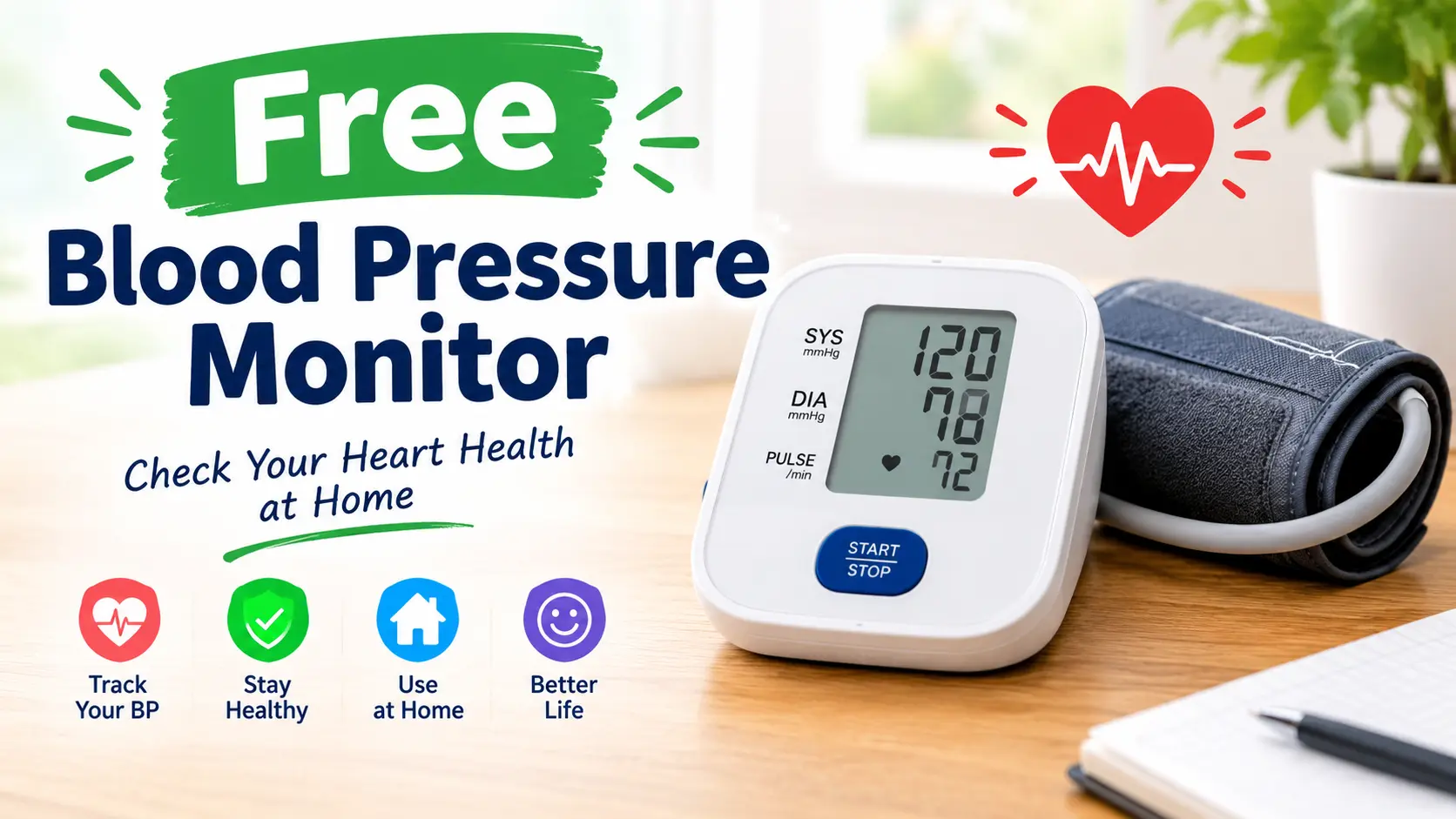
When people search for a free blood pressure monitor, they usually mean one of two very different things. Some want a free app to log their numbers.
Others want an actual cuff device at no cost. Those are not the same. An app records your readings. A cuff takes the reading.
And no, a standard smartphone cannot measure your blood pressure by itself. Here’s what’s genuinely free, what isn’t, and how to track your BP the right way.
What Is a Free Blood Pressure Monitor?
A free blood pressure monitor usually refers to a free app or online tracker that stores your readings, not a device that measures pressure.
Real measurement needs an inflatable cuff. Free apps create history logs, charts, and reminders. Free physical devices are rare and typically come through health camps, clinics, or insurance programs.
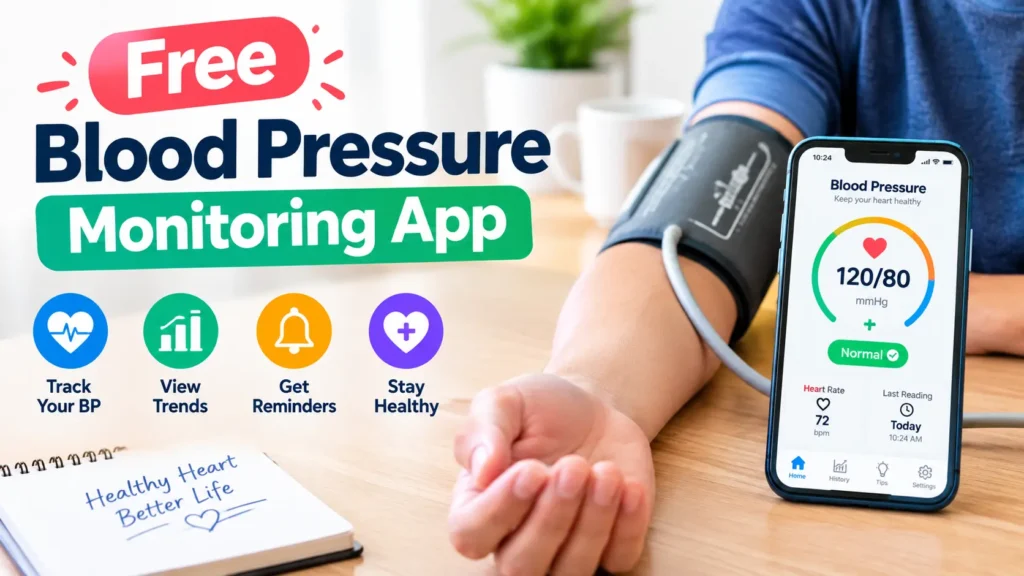
Free Blood Pressure Monitoring App
These apps save each systolic and diastolic number you enter. Over weeks, they build a chart. That trend line is often more useful to a doctor than one single reading.
Free Online BP Tracker
A browser-based diary. You type in readings by hand. Handy if you don’t want another app on your phone.
Free Physical Blood Pressure Monitor
An actual cuff costs money. But you can sometimes access one free through community health camps, hospital OPD waiting areas, some pharmacies, workplace wellness programs, or a relative who already owns one.
Can You Check Your Blood Pressure for Free?
Yes. You just may not own the device. I’ve sent plenty of people to their local clinic for this, and it takes five minutes.
Your free options:
- Borrow a home monitor from a family member or neighbour.
- Visit a health centre or clinic. Many check BP at no charge or a token fee.
- Pharmacy machines. Common in many cities, though accuracy varies.
- Community health camps run by hospitals, NGOs, or local government.
- Log it in a free app afterwards so the number isn’t lost.
A free BP monitor app doesn’t give you a free measurement. It gives you free record-keeping. Keep that distinction clear.
Can Your Phone Measure Blood Pressure Without a Cuff?
Short answer: not reliably, and not in any way you should trust for medical decisions.
Can Android Phones Measure Blood Pressure?
No. Android phones have no sensor that measures arterial pressure. Some apps claim otherwise. They’re estimating, not measuring.
Can iPhones Measure Blood Pressure?
No. The iPhone and Apple Watch measure heart rate and ECG rhythm. Neither measures blood pressure.
Can a Phone Camera Measure Blood Pressure?
Camera-based methods read blood flow changes in your fingertip. Researchers are working on this. It is not validated for home diagnosis, and results drift with lighting, skin tone, and finger pressure.
Can You Check BP With Your Finger?
Not accurately. Pulse oximeters and finger sensors give you heart rate and oxygen saturation. Blood pressure needs cuff compression of an artery.
Pro-Tip: If an app promises a BP reading with no cuff, check whether it says for entertainment purposes in the app store description. Many do, in small print. That line tells you everything.
Best Free Blood Pressure Monitor Apps
| App Type | What It Does | Actual BP Measurement? | Cost |
|---|---|---|---|
| BP Tracking App | Records readings, builds charts | No, needs external monitor | Free / Freemium |
| BP Diary App | Simple manual log | No | Free |
| Health Tracking App | Tracks weight, steps, BP, sleep | Only if paired with a device | Free / Freemium |
| Manufacturer App | Syncs from a Bluetooth cuff | Yes, via the cuff | Free with device |
What to look for before you install:
- Reading history you can scroll back through
- Charts showing morning vs evening patterns
- Reminders so you measure at the same time daily
- Data export as PDF or CSV
- Doctor sharing in one tap
- Privacy policy. Health data is sensitive. Check whether the app sells or shares it.
Skip apps that demand contacts or location access. A BP diary has no reason to need either.
How to Track Blood Pressure for Free
- Measure your BP using a home monitor, clinic, or borrowed cuff.
- Record the reading. Write down systolic over diastolic, plus pulse.
- Add date and time. Morning and evening readings differ a lot.
- Track multiple readings. One number means little. A week of numbers means something.
- Review the trend. Look for patterns, not individual spikes.
- Share the record with your doctor at your next visit.
A free spreadsheet works just as well as any app here.
How to Choose a Reliable Blood Pressure Monitor
If you’re buying one, these things matter more than brand name:
- Upper-arm over wrist. Upper-arm cuffs are generally more accurate.
- Correct cuff size. The single biggest cause of wrong readings. Measure your upper arm circumference and match it to the cuff range.
- Validation. Look for devices validated by recognised bodies like AAMI, ESH, or BIHS.
- Fully automatic inflation, so technique errors drop.
- Memory storage for at least 60 readings.
- Multiple user profiles if you share it at home.
- Irregular heartbeat detection.
- Warranty and service availability in your area.
Is an Upper-Arm Monitor Better for Home Use?
Usually, yes. Your wrist sits far from your heart, so small changes in arm position shift the reading. Upper-arm cuffs sit closer to heart level and wrap around a bigger artery.
How to Measure Blood Pressure Correctly at Home
- Rest quietly for five minutes first.
- Sit with your back supported.
- Keep both feet flat on the floor, legs uncrossed.
- Rest your arm on a table at heart level.
- Place the cuff on bare skin, just above the elbow.
- Stay silent during the measurement.
- Take two or three readings, one minute apart.
- Record the results.
Avoid caffeine, smoking, and exercise for 30 minutes before. Empty your bladder first. A full bladder can raise readings noticeably.
Free Blood Pressure App vs Physical BP Monitor
| Feature | Free BP App | Physical BP Monitor |
|---|---|---|
| Cost | Usually free | Paid |
| Records readings | Yes | Some models |
| Measures BP | No | Yes |
| Trend tracking | Yes | Limited |
| Useful for home monitoring | As a tracker only | Yes |
An app organises your blood pressure information. A cuff produces it. You need both, and only one of them is free.
Final Takeaway
Free apps are good at one job: keeping your numbers organised over time. They don’t measure anything.
If you need actual readings at home, a validated upper-arm monitor with the right cuff size is the tool for it.
Measure consistently, log everything, and take the record to your doctor. If your readings stay high or swing sharply, get that checked rather than tracked.
Frequently Asked Questions
Is there a completely free blood pressure monitor?
Free apps, yes. Free devices, rarely. Check community health camps, hospital screenings, or workplace wellness programs for free measurement access.
Is there a free blood pressure monitor app?
Yes. Many free apps log readings, build charts, and export reports. They record your numbers but cannot measure them.
Can I check my blood pressure with my phone?
You can record it on your phone. You cannot measure it with the phone alone. A cuff is required.
Can a phone measure blood pressure without a cuff?
No validated consumer phone does this today. Camera-based estimates remain experimental and are not suitable for medical decisions.
Are free blood pressure apps accurate?
The app is only as accurate as what you type in. Reading accuracy comes from the cuff and your technique.
Can I track my BP without buying a monitor?
Yes. Get measured at a clinic or pharmacy, then log the numbers in a free app or notebook.
What is the best way to monitor blood pressure at home?
A validated upper-arm monitor with the correct cuff size, used at the same times each day, with readings logged consistently.